bok
Afrikaans • Cebuano • Choctaw • Czech • Dutch • Kashubian • Lower Sorbian • Maranao • Marshallese • Middle English • Middle Low German • Norwegian Bokmål • Norwegian Nynorsk • Old Polish • Old Saxon • Old Swedish • Polish • Sarawak Malay • Serbo-Croatian • Silesian • Swedish • Tagalog • Turkish • Volapük
Page categories
Translingual
Symbol
bok
See also
- Wiktionary’s coverage of Bonjo terms
English
Pronunciation
- (General American) IPA(key): /bɑk/
- (Received Pronunciation, General South African) IPA(key): /bɒk/
- Rhymes: -ɒk
Audio (Southern England): (file)
Etymology 1
From Afrikaans bok. Doublet of buck. Compare German Bock (“willingness, desire”).
Adjective
bok
- (South Africa, slang) Keen or willing.
- "Do you want to go to the movies?" "Ja, I'm bok."
Etymology 2
Imitative
Interjection
bok
- The clucking sound of a chicken.
- Alternative form: bawk
- 2000, William S Pollack, Todd Shuster, Real boys' voices:
- And he says, "Chicken! Bok bok bok bok!" One time I got up and put the controller down and we started fighting.
- 2004, Andrew Bennett, Nicholas Royle, An introduction to literature, criticism and theory:
- So the librarian gives the chicken a book. The chicken goes away, but comes back the next day, goes up to the librarian's desk and says: 'Bok, bok!'
Verb
bok (third-person singular simple present boks, present participle bokking, simple past and past participle bokked)
- To make the clucking sound of a chicken.
See also
Anagrams
Afrikaans
Etymology
From Dutch bok (“buck, male goat”), from Middle Dutch boc, from Old Dutch buc, from Proto-Germanic *bukkaz.
Pronunciation
- IPA(key): /bɔk/
Audio: (file)
Noun
bok (plural bokke, diminutive bokkie)
- goat
- antelope, buck
- Synonym: wildsbok
- (slang) lover (term of affection)
- Synonym: bokkie
- (gymnastics) vaulting horse
- blunder
Derived terms
Descendants
- → Xhosa: ibhokhwe
Adjective
bok (attributive bokke, comparative bokker, superlative bokste)
Cebuano
Etymology
From Philippine English bok, from bunk, shortened from bunkmate.
Pronunciation
- Hyphenation: bok
Noun
bok
- one's batchmate or classmate in the Philippine Military Academy
Choctaw
Etymology
Attested as bayuk in the 17th century.
Noun
bōk (alienable)
Declension
| possessive (alienable) | singular | paucal | plural |
|---|---|---|---|
| first-person ("my, our") | a̱bōk | pi̱bōk | hapi̱bōk |
| second-person ("thy, your") | chi̱bōk | hachi̱bōk | |
| third-person ("his, her, its, their") |
i̱bōk | ||
| absolute | nominative | accusative | oblique | |
|---|---|---|---|---|
| neutral | bōk | bōkat | bōka̱ | bōkak |
| contrastive | bōkakō | bōkakōsh | bōkako̱ | bōkakakō |
| bōkato | bōkano | |||
| focus | bōkō | bōkakō | ||
| bōkōsh | bōko̱ |
| -ma "that, there" |
-pa "this, here" |
-kia "also, too" |
-ba "only" |
-ōk "but" |
-akhī pejorative |
|---|---|---|---|---|---|
| bōkma | bōkpa | bōk(ak)kia | bōkba | bōkōk | bōkakhī |
Derived terms
Descendants
Czech
Etymology
Inherited from Old Czech bok, from Proto-Slavic *bokъ.
Pronunciation
- IPA(key): [ˈbok]
Audio: (file)
Noun
bok m inan (diminutive boček or bůček)
Declension
Related terms
- boční
- bokový
- bokovka
- úbočí
- vbok
- odbočit
- vybočit
- zabočit
Further reading
- “bok”, in Příruční slovník jazyka českého (in Czech), 1935–1957
- “bok”, in Slovník spisovného jazyka českého (in Czech), 1960–1971, 1989
- “bok”, in Internetová jazyková příručka (in Czech), 2008–2026
Dutch
Pronunciation
- IPA(key): /bɔk/
Audio: (file) - Hyphenation: bok
- Rhymes: -ɔk
Etymology 1
From Middle Dutch boc, from Old Dutch buc, from Proto-West Germanic *bukk, from Proto-Germanic *bukkaz.
Noun
bok m (plural bokken, diminutive bokje n)
- male goat, billy
- Synonym: geitenbok
- buck, horse or pony; strong contraption on legs, resembling a mount
- (gymnastics) vaulting horse
- sawbuck
- Synonym: zaagbok
- a crane on legs
- box, perch (driver's seat on a carriage)
- (printing) job case, type case
- (derogatory) churl, grouch
- (derogatory) oaf, bumpkin
Derived terms
Descendants
- Afrikaans: bok
- → Xhosa: ibhokhwe
- → English: Bok
- Negerhollands: bok
- Sranan Tongo: boko, bokoboko
- Aukan: boko boko
Etymology 2
See the etymology of the corresponding lemma form.
Verb
bok
- inflection of bokken:
- first-person singular present indicative
- (in case of inversion) second-person singular present indicative
- imperative
Etymology 3
Proposed etymologies include Lokono bo-kia (“emphatic 'you'”), Lokono Lokono (“people, Arawak”), Portuguese botoque (“lip plate”), Portuguese bugre (“derogatory term for an Amerindian”). Compare English buck (“a black or Native American man”).
Noun
bok m (plural bokken, diminutive bokje n, feminine bokkin)
- (Suriname, obsolete) Amerindian person
- 1907, F.P. Penard, A.P. Penard, De menschetende aanbidders der zonneslang [The man-eating worshippers of the sun snake][1], Paramaribo: H.B. Heyde, pages 49-50:
- Dat echter een afgerichte negerslaaf beter te gebruiken was dan 50 Bokken klinkt wel wat ongelooflijk, in aanmerking genomen, dat thans nog algemeen onder de negers het verhaal de ronde doet, dat de weggeloopen slaven veel banger waren voor de Indianen dan voor de blanken of negersoldaten. Inderdaad in Demerara waren het de Bokken, die daar de vorming van onafhankelijk negerstaten belet hebben.
- However, that a trained Negro slave was more useful than fifty Amerindians sounds somewhat incredible, considering that even now the story is widely told among Negroes that runaway slaves were much more afraid of Indians than whites or Negro soldiers. Indeed, in Demerara, it were the Amerindians who prevented the formation of independent Negro nations.
Derived terms
- bokkendorp
- bokkengrond
- bokkenhout
- bokkenkatoen
- bokkennoot
- bokkenruilder
- bokraaf
Descendants
Etymology 4
Borrowed from Caribbean Javanese mbok.
Noun
bok f (uncountable, no diminutive)
Kashubian
Etymology
Pronunciation
- IPA(key): /ˈbɔk/
- Rhymes: -ɔk
- Syllabification: bok
Noun
bok m animal
Further reading
- Eùgeniusz Gòłąbk (2011), “kozioł”, in Słownik Polsko-Kaszubski / Słowôrz Pòlskò-Kaszëbsczi[2]
Lower Sorbian
Etymology
From Proto-Slavic *bokъ. Cognate with Upper Sorbian bok, Polish bok, Czech bok, Russian бок (bok), and Serbo-Croatian bȍk.
Pronunciation
Noun
bok m inan
- side (bounding straight edge of an object; flat surface of an object; left or right half; surface of a sheet of paper)
- page (one side of a leaf of a book)
- (chiefly in the dual) breast (organs on the front of a woman’s chest, which contain the mammary glands)
- Synonym: prědk
Declension
- Alternative locative singular: boce
Further reading
- Muka, Arnošt (1921, 1928), “bok”, in Słownik dolnoserbskeje rěcy a jeje narěcow (in German), St. Petersburg, Prague: ОРЯС РАН, ČAVU; Reprinted Bautzen: Domowina-Verlag, 2008
- Starosta, Manfred (1999), “bok”, in Dolnoserbsko-nimski słownik / Niedersorbisch-deutsches Wörterbuch (in German), Bautzen: Domowina-Verlag
Maranao
Etymology
From buhok, compare Tagalog buhok.
Noun
bok
- head hair
Marshallese
Etymology 1
(This etymology is missing or incomplete. Please add to it, or discuss it at the Etymology scriptorium.)
Pronunciation
Noun
bok (inalienable bokū) (alienable, pathology)
- blister
- Ebok peiū kōn an to aō jabōļ.
- I have a blister on my hand from shovelling so long.
- chicken pox
- Ear bok(e) ilo iiō eo ļọk.
- He had chicken pox last year.
Verb
bok (causative kōbok, distributive boke or bokboke) (intransitive, pathology)
- to have blisters or chicken pox
- Eboke ānbwinnin.
- His body is covered with pox.
Etymology 2
(This etymology is missing or incomplete. Please add to it, or discuss it at the Etymology scriptorium.)
Pronunciation
Noun
bok (inalienable boku or bowū or bukwō) (alienable, anatomy)
Etymology 3
(This etymology is missing or incomplete. Please add to it, or discuss it at the Etymology scriptorium.)
Pronunciation
Noun
bok (inalienable bokū) (alienable)
- warping (of wood)
- saturation with water
Verb
bok (causative intransitive kōbok, causative transitive kōboke) (intransitive)
- to be warped (of wood)
- Ebok bwiļāwut e.
- This plywood is warped.
- to be saturated with water
- Ebok būreej ņe.
- The biscuit is saturated with water.
Etymology 4
(This etymology is missing or incomplete. Please add to it, or discuss it at the Etymology scriptorium.)
Pronunciation
Noun
bok (alienable)
- a heated contest, climax (in games or competitions)
- Kwōjako jān an bok keem eo.
- You missed the part when the contest reached a climax.
Etymology 5
Pronunciation
Noun
bok (construct bokin) (alienable)
Verb
bok (transitive boke) (intransitive)
Etymology 6
From Proto-Micronesian *pʷeki. Compare Gilbertese bokaboka (“mud, mire”), Kosraean puhk (“sand”), fohk (“dirt, soil, ground”) and possibly Nauruan ebaubo (“mud, mire”). Doublet of bike.
Pronunciation
Noun
bok (inalienable boka, construct bokwan or bokwā) (alienable, geology)
- sand
- Bok in ia ņe ke eļap an mouj?
- Where is the sand from as it's really white?
- sandspit
- sandbar (usually not covered even at high tide)
Verb
bok (transitive boke, distributive bokboke, causative transitive kabokboke) (intransitive, geology)
- to cover with sand, to sand
- Eṃōj an ļadik eo boke kidu eo.
- The boy has already put sand on the dog.
- (distributive) to be sandy
- Ebokboke iaarin Majuro.
- The lagoon side of Majuro is sandy.
Derived terms
- bok aidik (“heat rash, measles”)
- bok ajaj (“coarse sand”)
- bok allōn̄ (“sand disks”)
- bokbok (“sandy”)
- bokkwelep (“coarse sand”)
- bokkwidik (“fine sand”)
- bokļap (“smallpox”)
- bokom̧ņa (“stony islet without trees”)
References
- Abo, Takaji; Bender Byron W.; Capelle, Alfred; DeBrum, Tony (2009–), “bok”, in Marshallese–English Online Dictionary[3]
- Nik Willson (2014), Naan[4], Majuro, Marshall Islands, page 936
Middle English
Alternative forms
Etymology
From Old English bōc, in turn from Proto-West Germanic *bōk, from Proto-Germanic *bōks.
Pronunciation
- IPA(key): /boːk/
Noun
bok (plural bokes)
- A document, especially if extensive and composed of bound pages:
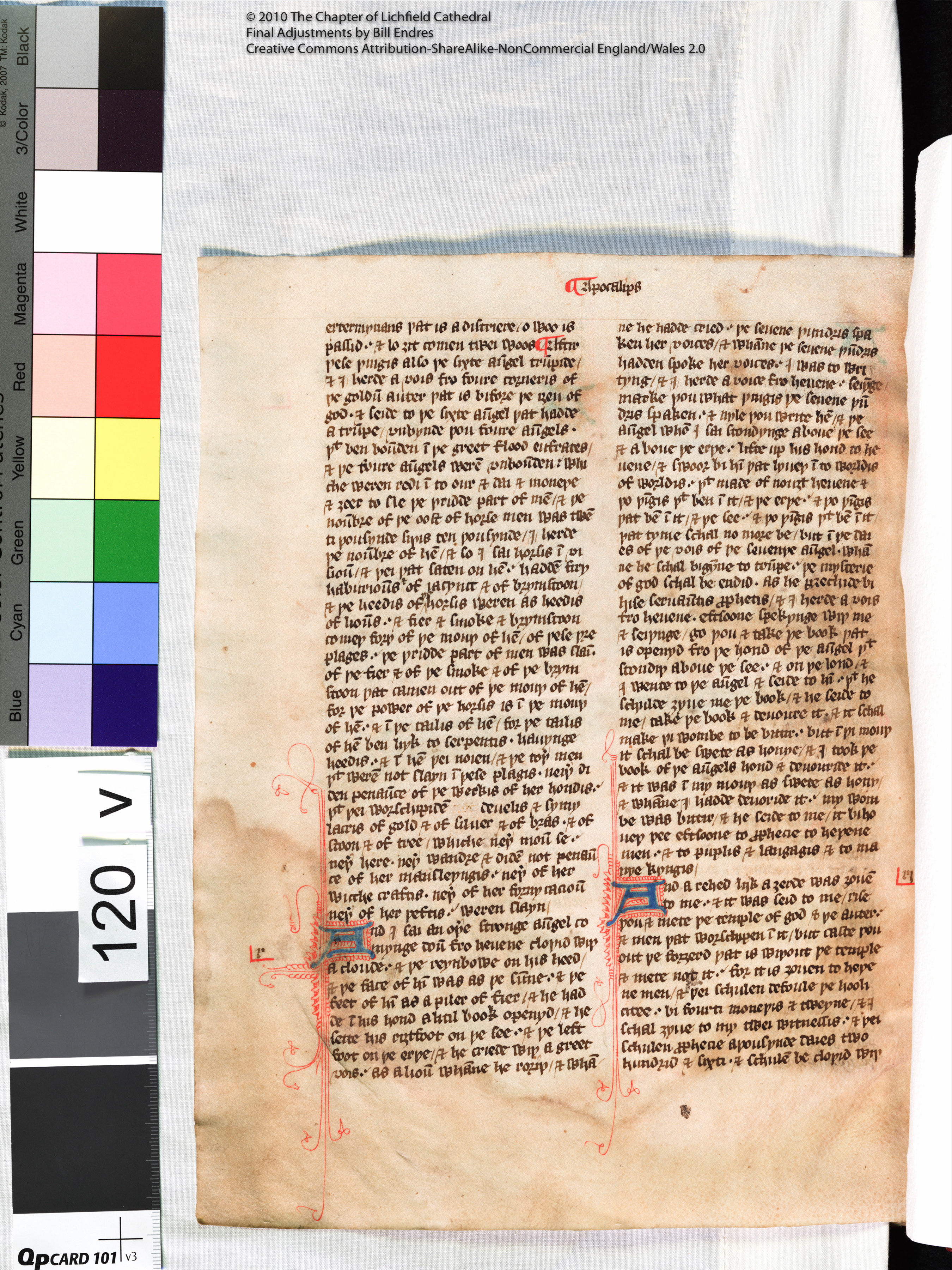
- c. 1395, John Wycliffe, John Purvey [et al.], transl., Bible (Wycliffite Bible (later version), MS Lich 10.)[5], published c. 1410, Apocalips 10:10, folio 120, verso, column 2; republished as Wycliffe's translation of the New Testament, Lichfield: Bill Endres, 2010:
- ⁊ I took þe book of þe aũgels hond ⁊ deuourıde ıt .· ⁊ ıt was ĩ my mouþ as ſwete as hony / ⁊ whãne I hadde deuorıde ıt .· my wombe was bıttır […]
- And I took the document from the angel's hand and consumed it; it seemed sweet like honey in my mouth, but when I'd eaten it, my stomach felt bitter.
- A notebook; a document kept empty for spontaneous use.
- A legal or governmental record or register.
- An account book or ledger; a financial record.
- A book; an extended written work:
- c. 1180, Orͬm, “[Preface]”, in Orͬmulum (Bodleian MS. Junius 1), Bourne Abbey, Lincolnshire, folio 9, recto; republished at Oxford: Digital Bodleian, 10 January 2019:
- Þiſſ boc ıſſ nẽ̃nedd. orͬmulũ⹎ forͬþı ꝥ orͬm ıtt ƿrohhte⹎ ⁊ ıtt ıſſ ƿrohͪt off quaþþrıꟑan. off ꟑoddſpellbokeſſ foƿƿre.
- This book is called the "Ormulum" since Orm made it. It's made out of a quadriga; out of the four Gospels […]
- A volume or fascicle of a larger work.
- A particular book (especially the Bible)
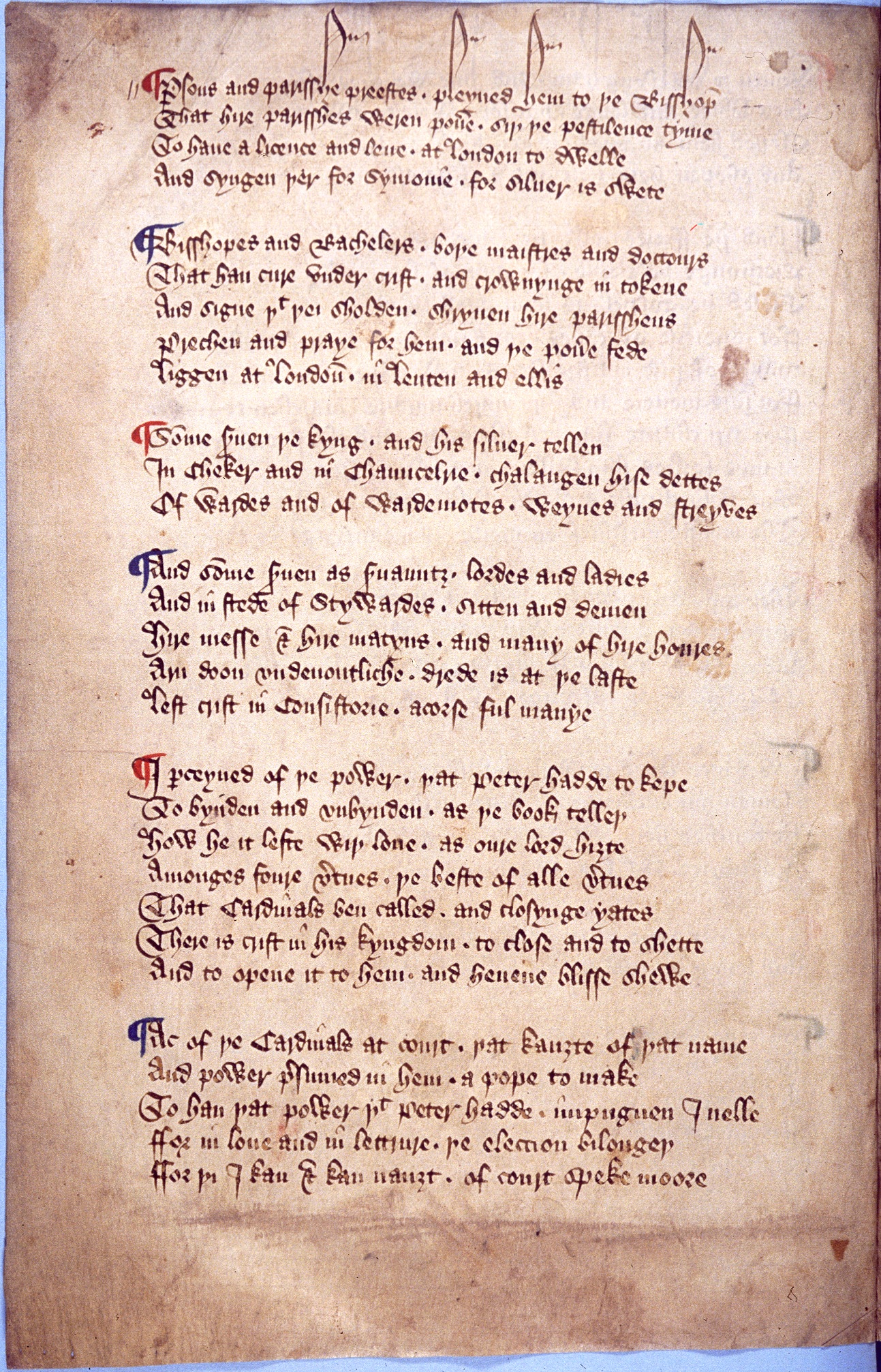
- c. 1378-9, [William Langland], “[Prologue]”, in [Piers Plowman, A Treatise on Sin] (W, B-text), London, published c. 1400, →OCLC, folio 2, verso; republished as Thorlac Turville-Petre, Hoyt N. Duggan, editors, Cambridge, Trinity College, MS B.15.17 (The Piers Plowman Electronic Archive; 2), SEENET, 2014, →ISBN:
- I ꝑrceyued of þe power. þat Peter hadde to kepe / To bynden and vnbynden. as þe book telleþ
- I comprehended the power that Peter had to maintain: / to lock and unlock, as the [Good] Book says […]
- (figuratively) Knowledge, ethics or a source of them.
Related terms
Descendants
References
- “bọ̄k, n.(1).”, in MED Online, Ann Arbor, Mich.: University of Michigan, 2007.
Middle Low German
Alternative forms
Etymology
From Old Saxon bōk, from Proto-West Germanic *bōk, from Proto-Germanic *bōks.
Pronunciation
- Stem vowel: ô¹
- (originally) IPA(key): /boːk/
Noun
bôk n
Descendants
Norwegian Bokmål
Pronunciation
- IPA(key): /buːk/
Audio: (file)
Etymology 1
Inherited from Danish bog with native Norwegian -k, from Old Norse bók (“book”), from Proto-Germanic *bōks (“letter”), which see. Often thought to be related with etymology 2 below.
Noun
bok f or m (definite singular boka or boken, indefinite plural bøker, definite plural bøkene)
Usage notes
- One of the nouns whose feminine form is predominant in formal writing.
Derived terms
Etymology 2
Probably from dialectal Norwegian. Alternatively from Danish bog (“beechnut”), for which Norwegian says bøkenøtt.
Noun
bok f or m (definite singular boka or boken, indefinite plural boker, definite plural bokene)
- alternative form of bøk (“beech”)
References
Norwegian Nynorsk
Alternative forms
- bók (Setesdal, dialects)
Etymology
From Old Norse bók, from Proto-Germanic *bōks. Akin to English book, German Low German Book.
Pronunciation
- IPA(key): /buːk/, [bu̞ːk]
Noun
bok f (definite singular boka, indefinite plural bøker, definite plural bøkene)
Derived terms
References
- “bok” in The Nynorsk Dictionary.
Old Polish
Etymology
Inherited from Proto-Slavic *bokъ. First attested in the 13th century.
Pronunciation
Noun
bok m inan (related adjective bokowy)
- (anatomy, attested in Masovia, Lesser Poland, Silesia, Greater Poland) side, flank (neither the front nor the back; lateral part of a person or animal)
- c. 1500, Wokabularz lubiński, Lubiń: inkunabuł Archiwum Archidiecezjalnego w Gnieźnie, sygn. Inc. 78d., page 73v:
- Latus […] a lateo lates eyn seyt bok
- [Latus […] a lateo lates eyn seyt bok]
- side, flank (neither the front nor the back of an object)
- 1939 [end of the 14th century], Ryszard Ganszyniec, Witold Taszycki, Stefan Kubica, Ludwik Bernacki, editors, Psałterz florjański łacińsko-polsko-niemiecki [Sankt Florian Psalter]scan transliteration, transcription, numbers 47, 2, Krakow: Zakład Narodowy imienia Ossolińskich, z zasiłkiem Sejmu Śląskiego [The Ossoliński National Institute: with the benefit of the Silesian Parliament]:
- Zacladana iest weselim wszelika zema gora Syon: boky polnoczi, masto crola welikego (fundatur exultatione universae terrae mons Sion: latera aquilonis, civitas regis magni)
- [Zakładana jest wiesielim wszelikiej ziemie gora Syjon, boki północy, miasto króla wielikiego (fundatur exultatione universae terrae mons Sion: latera aquilonis, civitas regis magni)]
Derived terms
- boczyć impf
Descendants
References
- Boryś, Wiesław (2005), “bok”, in Słownik etymologiczny języka polskiego (in Polish), Kraków: Wydawnictwo Literackie, →ISBN
- Mańczak, Witold (2017), “bok”, in Polski słownik etymologiczny (in Polish), Kraków: Polska Akademia Umiejętności, →ISBN
- Bańkowski, Andrzej (2000), “bok”, in Etymologiczny słownik języka polskiego [Etymological Dictionary of the Polish Language] (in Polish)
- Sławski, Franciszek (1958-1965), “bok”, in Jan Safarewicz, Andrzej Siudut, editors, Słownik etymologiczny języka polskiego [Etymological dictionary of the Polish language] (in Polish), Kraków: Towarzystwo Miłośników Języka Polskiego
- B. Sieradzka-Baziur, Ewa Deptuchowa, Joanna Duska, Mariusz Frodyma, Beata Hejmo, Dorota Janeczko, Katarzyna Jasińska, Krystyna Kajtoch, Joanna Kozioł, Marian Kucała, Dorota Mika, Gabriela Niemiec, Urszula Poprawska, Elżbieta Supranowicz, Ludwika Szelachowska-Winiarzowa, Zofia Wanicowa, Piotr Szpor, Bartłomiej Borek, editors (2011–2015), “bok”, in Słownik pojęciowy języka staropolskiego [Conceptual Dictionary of Old Polish] (in Polish), Kraków: IJP PAN, →ISBN
- Ewa Deptuchowa, Mariusz Frodyma, Katarzyna Jasińska, Magdalena Klapper, Dorota Kołodziej, Mariusz Leńczuk, Ludwika Szelachowska-Winiarzowa, Zofia Wanicowa, editors (2023), “bok”, in Rozariusze z polskimi glosami. Internetowa baza danych [Dictionaries of Polish glosses, an Internet database] (in Polish), Kraków: Pracownia Języka Staropolskiego Instytut Języka Polskiego Polskiej Akademii Nauk
Old Saxon
Alternative forms
Etymology
From Proto-West Germanic *bōk, from Proto-Germanic *bōks, whence also Old English bōc, Old Frisian bōk, Old High German buoh, Old Norse bók.
Noun
bōk f or n
Declension
| singular | plural | |
|---|---|---|
| nominative | bōk | bōki |
| accusative | bōk | bōki |
| genitive | bōki | bōkiō |
| dative | bōki | bōkium |
| instrumental | — | — |
| singular | plural | |
|---|---|---|
| nominative | bōk | bōk |
| accusative | bōk | bōk |
| genitive | bōkes | bōkō |
| dative | bōke | bōkun |
| instrumental | — | — |
Descendants
Old Swedish
Alternative forms
- ᛒᚮᚴ (Runic)
Etymology
From Old Norse bók, from Proto-Germanic *bōks.
Noun
bōk f
Declension
| singular | plural | |||
|---|---|---|---|---|
| indefinite | definite | indefinite | definite | |
| nominative | bōk | bōkin, bōkren bōkerin, bōkeren bōkern |
bø̄ker | bø̄krina, bø̄krinar, bø̄krena, bø̄krenar |
| accusative | bōk | bōkina, bōkena | bø̄ker | bø̄krina, bø̄krinar, bø̄krena, bø̄krenar |
| dative | bōk | bōkinni, bōkinne | bōkum, bōkom | bōkumin, bōkomen |
| genitive | bōka, bōkar | bōkinna, bōkinnar | bōka | bōkanna |
Descendants
Polish
Pronunciation
Etymology 1
Inherited from Old Polish bok.
Noun
bok m inan (related adjective boczny)
- (anatomy) side, flank (neither the front nor the back; lateral part of a person, animal)
- (Middle Polish) physical or emotional closeness to someone
- side, flank (neither the front nor the back; lateral part of an object)
- Synonym: strona
- side (place in space located to the right or left of some central reference point)
- (geometry) side (segment connecting two vertices of a polygon)
- side (place out of the way)
- (obsolete, mining) shaft wall
- (Middle Polish, collective, metonomically) man; human community; group
- (Middle Polish) side; Further details are uncertain.
- 1528, J. Murmelius, Dictionarius[7], page 60:
- Latus Bok
- [Latus Bok]
Declension
Derived terms
- mieć na boku impf
- odłożyć na bok pf, odkładać na bok impf
- podeprzeć się pod boki pf, podpierać się pod boki impf
- popatrzeć z boku pf, patrzeć z boku impf
- skakać na boki impf
- stać z boku impf
- stanąć z boku pf, stawać z boku impf
- wyjść bokiem pf, wychodzić bokiem impf
- zrywać boki impf
Derived terms
- bocznie
- pobocznie
Etymology 2
See bąk.
Noun
bok m animal
Further reading
- “bok”, in Wielki słownik języka polskiego[8] (in Polish), Instytut Języka Polskiego PAN
- “bok”, in Polish dictionaries at PWN[9] (in Polish)
- Maria Renata Mayenowa; Stanisław Rospond; Witold Taszycki; Stefan Hrabec; Władysław Kuraszkiewicz (2010-2023), “bok”, in Słownik Polszczyzny XVI Wieku [A Dictionary of 16th Century Polish]
- Wiesław Morawski (23.10.2012), “BOK”, in Elektroniczny Słownik Języka Polskiego XVII i XVIII Wieku [Electronic Dictionary of the Polish Language of the XVII and XVIII Century]
- Samuel Bogumił Linde (1807–1814), “bok”, in Słownik języka polskiego
- Aleksander Zdanowicz (1861), “bok”, in Słownik języka polskiego, Wilno 1861
- J. Karłowicz, A. Kryński, W. Niedźwiedzki, editors (1900), “bok”, in Słownik języka polskiego (in Polish), volume 1, Warsaw, page 186
- bok in Narodowy Fotokorpus Języka Polskiego
Sarawak Malay
Alternative forms
Etymology
Syncopic form of baruk
Pronunciation
- IPA(key): /boʔ/
Adverb
bok
- (syncopated) alternative form of baruk
- Ya bok nya!
- Now, that is it!
Serbo-Croatian
Etymology 1
Inherited from Proto-Slavic *bokъ.
Pronunciation
- IPA(key): /bôːk/, /bôk/
Noun
bȏk or bȍk m inan (Cyrillic spelling бо̑к or бо̏к)
Declension
| singular | plural | |
|---|---|---|
| nominative | bȏk | bòkovi |
| genitive | bȍka | bòkōvā |
| dative | bȍku | bòkovima |
| accusative | bȏk | bòkove |
| vocative | bȍče | bòkovi |
| locative | bòku | bòkovima |
| instrumental | bȍkom | bòkovima |
The accent shift is non-weakened: nȁ bōk.
Usage notes
- Also can occur as a.p. B in western dialects: bȍk, bòka... (Milas 1903:95 (49), ŠRHJ, Kapović 2010).
- Daničić (ARj) provides short falling in plural: bȍkovi, bȍkōvā...
- Older attestations:
- Vrančić 1595: Book (Lumbus)
- Micalia 1649: bók
- Della Bella 1728: Book, ód bokka (Lato)
- Belostenec 1740: Bòki / (D[ubrovnik]) boczi
- Stulli 1806: Bōk, okka
- Dialectal attestations:
- Lužnica (Ćirić): bo̍k, bo̍kovi
- Mostar (Milas, p.95 (49)): bȍk, bòka
- Novi Vinodolski (Беличъ, p.209): bȏk, bȍka
- Susak (Hamm/Hraste/Guberina, p.106): buȏk, bŏkȁ [a.p. D?]
- Varaždin (Lipljin): b'ok, bȏka, [Gpl] bokȏf
- Vrgada (Jurišić): bȏk, bȍka
Etymology 2
From Bog (shortened from a greeting such as Bog s tobom, zdravobog,[1] etc.) by devoicing of the final consonant typical in Kajkavian dialects.[2] Attested in Zagreb colloquial usage since mid-20th century.[3] A widespread alternative etymology proposes a fictional Austrian German greeting mein Bücken (supposedly "my bow"); the etymology is not acceptable, as the greeting is not attested in German,[4] and the usual loanword adaptation into Croatian would yield a different phonetic form.
Alternative forms
Pronunciation
- (Zagreb) IPA(key): /bok/
Interjection
bok (Cyrillic spelling бок)
Footnotes
References
- ARj = Đuro Daničić, editor (1880–1882), “bȏk”, in Rječnik hrvatskoga ili srpskoga jezika[10] (in Serbo-Croatian), volume 1, Zagreb: JAZU, page 518
- Babić, Ivana (2019). Leksikografske dvojbe na jednome školskom primjeru. Hrvatski jezik 6/1.
- ERHJ = Matasović, Ranko, Dunja Brozović Rončević, Dubravka Ivšić Majić, Tijmen Pronk (2016), “bok”, in Matasović, Ranko, editor, Etimološki rječnik hrvatskoga jezika [Etymological dictionary of the Croatian language] (in Serbo-Croatian), volume I: A – Nj, Zagreb: Institut za hrvatski jezik i jezikoslovlje, page 73
- Kapović, Mate (2010). Naglasak o-osnova muškoga roda u hrvatskom — povijesni razvoj. Filologija 54.
- Magner, Thomas (1966). A Zagreb Kajkavian Dialect. Penn.: Pennsylvania State University.
- Milas, Matej (1903). Današńi mostarski dijalekat. Rad JAZU 153 (60).
Silesian
Etymology
Inherited from Old Polish bok.
Pronunciation
- IPA(key): /ˈbɔk/
Audio: (file) - Rhymes: -ɔk
- Syllabification: bok
Noun
bok m inan (related adjective boczny)
Declension
| singular | plural | |
|---|---|---|
| nominative | bok | boki |
| genitive | boku | bokōw |
| dative | bokowi | bokōm |
| accusative | bok | boki |
| instrumental | bokym | bokami/bokōma |
| locative | boku | bokach |
| vocative | boku | boki |
Further reading
- bok in dykcjonorz.eu
- bok in silling.org
- Henryk Jaroszewicz (2022), “bok”, in Zasady pisowni języka śląskiego (in Polish), Siedlce: Wydawnictwo Naukowe IKR[i]BL, page 65
- Aleksandra Wencel (2023), “bok”, in Dykcjůnôrz ślų̊sko-polski, page 70
Swedish
Pronunciation
- IPA(key): /buːk/
Audio: (file)
Etymology 1
From Old Swedish bōk, from Old Norse bók, from Proto-Germanic *bōks, of uncertain origin but usually connected to Proto-Indo-European *bʰeh₂ǵ- (“beech”) or Proto-Indo-European *bʰeh₂g- (“to allot”).
Noun
bok c
- book:
- collection of sheets of paper
- a work of literature
- läsa en bok
- read a book
- skriva en bok
- write a book
- bläddra i en bok
- flip/leaf through a book, (sometimes, by implication) browse through a book
- a major division of a published work
Declension
| nominative | genitive | ||
|---|---|---|---|
| singular | indefinite | bok | boks |
| definite | boken | bokens | |
| plural | indefinite | böcker | böckers |
| definite | böckerna | böckernas |
Derived terms
- anteckningsbok
- barnbok
- boka
- bokanmälan
- bokantikvariat
- bokare
- bokauktion
- bokband
- bokbar
- bokbestånd
- bokbindare
- bokbinderi
- bokbindning
- bokbord
- bokbuss
- bokbål
- bokcafé
- bokcirkel
- bokfilm
- bokflod
- bokform
- bokformat
- bokföra
- bokförare
- bokföring
- bokförlag
- bokförläggare
- bokförsäljare
- bokhandel
- bokhylla
- bokhållare
- bokillustration
- bokkafé
- bokklubb
- boklig
- boklåda
- boklån
- boklärd
- bokläsare
- bokmal
- bokmarknad
- bokmoms
- bokmål
- bokmärke
- bokmässa
- bokning
- bokomslag
- bokpris
- bokpärm
- bokrea
- bokrecenssion
- bokrulle
- bokrygg
- boksamlare
- boksamling
- bokserie
- boksida
- bokskåp
- bokslukare
- bokslut
- bokstav
- bokstavera
- bokstavering
- bokstavlig
- bokstavligen
- bokstöd
- boksynt
- boktitel
- boktryck
- boktryckare
- boktryckeri
- bokutgivning
- bokutlåning
- bokvagn
- bokverk
- bokälskare
- bredvidläsningsbok
- dagbok
- dödbok
- faktabok
- flickbok
- föra bok
- handbok
- historiebok
- huvudbok
- kyrkbok
- loggbok
- läsebok
- läxbok
- ordbok
- plånbok
- pocketbok
- pojkbok
- räknebok
- sagobok
- skrivbok
- textbok
- ungdomsbok
- uppslagsbok
- vaxduksbok
- årsbok
- äventyrsbok
Etymology 2
From Old Swedish bōk, from Old Norse bók, from Proto-Germanic *bōkō, from Proto-Indo-European *bʰeh₂ǵos.
Noun
bok c
Declension
| nominative | genitive | ||
|---|---|---|---|
| singular | indefinite | bok | boks |
| definite | boken | bokens | |
| plural | indefinite | bokar | bokars |
| definite | bokarna | bokarnas |
Derived terms
Descendants
- → English: Bok
References
- “bok”, in Svensk ordbok [Dictionary of Swedish] (in Swedish)
- “bok”, in Svenska Akademiens ordlista [Wordlist of the Swedish Academy] (in Swedish)
- “bok”, in Svenska Akademiens ordbok [Dictionary of the Swedish Academy] (in Swedish)
Tagalog
Etymology
A play on English bunk, shortened from bunkmate.
Pronunciation
- (Standard Tagalog) IPA(key): /ˈbok/ [ˈbok̚]
- Rhymes: -ok
- Syllabification: bok
Noun
bok (Baybayin spelling ᜊᜓᜃ᜔) (military slang)
- one's batchmate or classmate in the Philippine Military Academy
See also
Turkish
Etymology
From Ottoman Turkish بوق (bok, “excrement, dung, turd, shit”), from Old Anatolian Turkish پوخ (poḫ), from Proto-Turkic *bok (“dirt, dung”).
Cognate with Kazakh боқ (boq), Azerbaijani pox, Kyrgyz бок (bok), etc.
Pronunciation
- IPA(key): /bok/
Audio: (file)
Noun
bok (definite accusative boku, plural boklar)
- (vulgar) shit (solid excretory product evacuated from the bowel)
- Synonyms: dışkı, (childish) kaka, thesaurus:dışkı
- Bok ye, amcık!
- Eat shit, cunt!
- (metallurgy) slag, dross
- (vulgar) a hard situation
- Öyle bir bokun içindeyim ki şuan.
- I'm so deep in some shit now.
Declension
| |||||||||||||||||||||||||||||||||||||||||||||||||||||||||||||||||||||||||||||||||||||||||||||||||||||||||||||||||||||||||||||||||||||||||||||||||||||||||||||||||||||
Adjective
bok
Derived terms
- akım derken bokum demek
- aklı bokuna karışmak
- bir boka yaramamak
- bok atmak
- bok boku kenefte bulur
- bok böceği
- bok canına olsun
- bok çukuru
- bok etmek
- bok gibi
- bok götürmek
- bok karıştırmak
- bok püsür
- bok soyu
- bok üstün bok
- bok yedi başı
- bok yemek
- bok yemek düşer
- bok yemenin Arapçası
- bok yoluna gitmek
- boka batmak
- boka düşmek
- boka nispetle tezek amberdir
- boka sarmak
- boklama
- boklamak
- boklanmak
- boklaşmak
- boklu
- bokluk
- bokmanlı
- boktan
- boku bokuna
- boku çıkmak
- bokun soyu
- bokunda boncuk bulmak
- bokunu çıkarmak
- bokuyla kavga etmek
- bombok
- demir boku
- düşün düşün, boktur işin
- iki ucu boklu değnek
- karga bok yemeden
- karga ile gezen boka konar
- kazboku
- ödü bokuna karışmak
- siktirboktan
- soydur çeker, boktur kokar
- tabakhaneye bok mu yetiştiriyorsun
Further reading
- “bok”, in Turkish dictionaries, Türk Dil Kurumu
- Ayverdi, İlhan (2010), “bok”, in Misalli Büyük Türkçe Sözlük, a reviewed and expanded single-volume edition, Istanbul: Kubbealtı Neşriyatı
- Nişanyan, Sevan (2002–), “bok”, in Nişanyan Sözlük
Volapük
Etymology
Borrowed from English box (boks).
Pronunciation
- IPA(key): /bok/
Noun
bok (genitive boka, plural boks)
Declension
| Singular | Plural | |
|---|---|---|
| Nominative | bok | boks |
| Genitive | boka | bokas |
| Dative | boke | bokes |
| Accusative | boki | bokis |
| Predicative1 | boku | bokus |
| Vocative | o bok | o boks |
- Introduced in Volapük Nulik.
Derived terms
- bokil (“little box / small box”) (diminutive)
- bokül
See also
Further reading
- “bok”, in Vödabuk (in English, Esperanto, and Volapük)