not
Albanian • Ambonese Malay • Aromanian • Danish • German • Icelandic • Indonesian • Latin • Lower Tanana • Luxembourgish • Michif • Middle English • Norwegian Nynorsk • Old Dutch • Old English • Old High German • Old Irish • Old Saxon • Old Swedish • Romansh • Scottish Gaelic • Swedish • Tok Pisin • Turkish • Welsh
Page categories
Translingual
Etymology
Abbreviation of English Nomatsiguenga.
Symbol
not
See also
- Wiktionary’s coverage of Nomatsiguenga terms
English
Etymology
From Middle English not, nat, a variant of noght, naht (“not, nothing”), from Old English *nōht, nāht (“nought, nothing”), shortening of nōwiht, nāwiht (“nothing”, literally “not anything”), corresponding to ne (“not”) + ōwiht, āwiht (“anything”), corresponding to ā (“ever, always”) + wiht (“thing, creature”).
Cognate with Scots nat, naucht (“not”), Saterland Frisian nit (“not”), West Frisian net (“not”), Dutch niet (“not”), German nicht (“not”). Compare nought, naught and aught. More at no, wight, whit.
Pronunciation
- (Received Pronunciation) IPA(key): /nɒt/
Audio (London): (file)
- (Standard Southern British) IPA(key): /nɔt/
Audio (UK): (file)
- (General American, dialects of Canada) IPA(key): /nɑt/
Audio (US): (file)
- (Canada, dialects of the US) IPA(key): /nɒt/
- (General Australian) IPA(key): /nɔt/
- (New Zealand) IPA(key): /nɒt/, [nɔ̟t]
- (Ireland) IPA(key): [nɞt]
- (Local Dublin) IPA(key): [näʔ]
- Homophone: knot
- Homophones: naught, nought (cot–caught merger)
- Rhymes: -ɒt
Adverb
not (not comparable)
- Negates the meaning of the modified verb.
- Did you take out the trash? — No, I did not. I do not think it was my turn, was it?
- Not knowing any better, I went ahead.
- It was felt desirable that she not leave school before fourteen.
- I'd rather MoM (did) not stay, cuz the best thing about a holiday is not working.
- Not a day passes when I don't regret not having enrolled in medicine.
- 1973 November 17, Richard Milhous Nixon, Orlando press conference:
- 1991 September, Stephen Fry, chapter 2, in The Liar, London: Heinemann, →ISBN, section I, page 42:
- The sound of Abba singing ‘Dancing Queen’ had started up in a room the other side of the court. Adrian slammed the window shut.
‘That’ll teach you to throw things out of the window,’ said Gary.
‘It’ll teach me not to throw things out of the window.’
- 1998 January 26, William Jefferson Clinton, White House press conference:
- I want to say one thing to the American people. I want you to listen to me. I'm going to say this again: I did not have sexual relations with that woman, Miss Lewinsky.
- 2016, VOA Learning English (public domain)
- Oh, Pete. This is not the gym. — That’s right, Anna. This is the mailroom.
- To no degree.
- That is not red; it's green.
- 1984 December 22, John Stout, “Home for the Holidays: Survival Strategies for Gays”, in Gay Community News, volume 12, number 23, page 5:
- Expectation: Everybody in the family has to love everybody else.
Reaction: Not the ghost of Christmas past, present, or future could pull this one off unless feeling is already there.
- (litotes) Used to indicate the opposite or near opposite, often in a form of understatement.
- That day was not the best day of my life. (meaning the day was bad or awful)
- It was not my favorite movie of all time. (meaning the speaker dislikes or strongly dislikes the movie)
- In the not too distant future my view on the matter might be not a million miles away from yours.
- I wonder if I shouldn't see a doctor - I've been feeling funny the last few days.
- Used before a determiner phrase, a pronominal phrase etc. to convey a negative attitude (e.g. denial, sadness, anger) towards something.
- Oh god, not that! Anything but that!
- Not another rainy day!
- (ironic, informal, originally African-American Vernacular) Used before a non-finite clause (especially a gerund-participial clause) or less commonly a determiner phrase to ironically convey some attitude (e.g. surprise, incredulity, amusement, embarrassment) towards something. [attested since the late 2000s, popularized around 2020][1][2]
- Not me writing example sentences again. ― Oh my, there I go writing example sentences again!
- 2023 July 8, @brielarson [Brie Larson], Twitter[1]:
- Not me crying by the end of that!! You are a brilliant, beautiful human who deserves no less than the world. Thank you for taking the time to watch unicorn store. It’s a film that means so much to me.
- 2023 December 9, “Keke Palmer and Darius Jackson: A Complete Relationship Timeline”, in Glamour[2]:
- [Keke] Palmer tells Hoda Kotb and Jenna Bush Hager to “mind y'all's business” when they ask about her relationship with [Darius] Jackson. ¶ “Not y’all trying to get into it! They trying it on the Today show,” Palmer joked when the subject was first brought up on Today With Hoda & Jenna.
Usage notes
In modern usage, do-support requires that the form do not ... (or don’t ...) be preferred to ... not for all but a short list of verbs (be, have, can, could, shall, should, will, would, may, might, must, need, ought):
- They do not sow. (modern) vs. They sow not. (KJB)
American usage tends to prefer don’t have or haven’t got to have not or haven’t, except when have is used as an auxiliary (or in the idiom have-not):
- I don’t have a clue or I haven’t got a clue. (US)
- I haven’t a clue or I haven’t got a clue. (outside US)
- I haven’t been to Spain. (universal)
The verb need is only directly negated when used as an auxiliary; this usage is rare in the US but common elsewhere.
- You don’t need to trouble yourself. (common in US)
- You needn’t trouble yourself. (common outside US)
- I don’t need any eggs today. (universal)
The verb dare can sometimes be directly negated.
- I daren't do that.
The verb do, as a main verb, takes do not.
- He does not do that.
In the imperative, all verbs, including be, take do not.
- Don't do that.
- Don't be silly. (not *Be not silly.)
In the infinitive, verbs must be negated directly. In this case not cannot appear after the verb; some authorities recommend placing it before to to avoid a split infinitive, but for most speakers the forms not to do and to not do are more or less interchangeable, with the latter being mostly informal.
- The objective is not to lose or The objective is to not lose.
- I wanted not to go or I wanted to not go. (Note the difference between this and I didn't want to go, where want is the verb being negated.)
In the subjunctive mood, do-support is not used for negation; not is placed by itself, or with should, immediately before the verb it modifies, even be:
- They suggested that he (should) not do it.
- The law requires that it (should) not be done.
Derived terms
Related terms
Translations
|
Conjunction
not
- And not.
- I wanted a plate of shrimp, not a bucket of chicken.
- He painted the car blue and black, not solid purple.
- We can't run this bar without her. Not and raise two kids.
Usage notes
- The construction “A, not B” is synonymous with the constructions “A, and not B”; “not B, but A”; and “not B, but rather A”.
Translations
|
Interjection
not!
- (slang) Used to indicate that the previous phrase was meant sarcastically or ironically. [chiefly 1990s]
- Coordinate term: just kidding
- Near-synonyms: I don't think; psych; bender (obsolete, UK)
- I really like hanging out with my little brother watching Barney … not!
- Sure, you’re perfect the way you are … not!
- 1911 March, Zane Grey, “Out on the Field”, in The Young Pitcher, New York, N.Y.: Grosset & Dunlap, →OCLC, page 64:
- You've got a swell chance to make this [baseball] team, you have, not! Third base is my job, Freshie. Why, you tow-head, you couldn't play marbles. You butter-finger, can't you stop anything?
- 1949, E.E 'Doc' Smith, chapter XIV, in Skylark of Valeron, London: Panther, published 1974, page 134:
- "See?" "Uh-huh! Clear and lucid to the point of limpidity - 'not."
- 1995, Paul Vautin, Turn It Up!, Sydney: Pan Macmillan Australia, page 42:
- After Seaworld it was down to Tijuana in Mexico. Charming place - not.
Translations
See also
- Appendix:American Dialect Society words of the year
Noun
not (plural nots)
- An instance of using the word “not”; a negation or denial.
- 1922 March 4, “Fed on Fear Too Much”, in The Pathfinder, volume 29, number 1470, Washington, D.C.: Pathfinder Publishing Company, page 33:
- The children are taught to be afraid of winter, of war, of death, of hard times, of disease, of examinations. Perhaps that is one of the reasons that children so seldom find the conversation of their elders uplifting. It is full of don’ts, buts and nots.
- Alternative letter-case form of NOT (“unary operation on logical values that changes true to false, and false to true”).
Usage notes
Boolean operators and states are commonly written in all uppercase in order to distinguish them from the ordinary uses of the words.
Translations
See also
References
- ^ Colin Morris (11 April 2021), “Not them having a whole zoo—the rise of ironic "not"”, in colin_morris
- ^ Guilherme M. C. Pereira (19 December 2023), “Not me getting with the times: A new kind of not-fragment in English”, in Yale Working Papers in Grammatical Diversity, volume 5, number 1, Yale University Department of Linguistics
Further reading
- “not”, in OneLook Dictionary Search.
Anagrams
Albanian
Pronunciation
- IPA(key): /ˈnot/
- Rhymes: -ot
Etymology 1
From a deverbal of Latin natāre, *notāre, compare Italian nuoto. A direct verbal borrowing would have regularly yielded **nëtoj instead of attested notoj, which must be a secondary derivation from the noun. Earliest attestations start with /mn/, likely due rebracketing of expressions such as i bie m not, compare Romanian înota.
Alternative forms
- mnot — dialectal
- nod — dialectal
Noun
not m (definite noti)
- (uncountable) swim, swimming (act of swimming or ability to swim)
- bëj not ― to swim
- ra not ― to swim
- di not ― to know how to swim
- mësoj not ― to learn how to swim
- (dialectal) swimmer
- Synonym: notar
Derived terms
References
- FGJSSH (1980), page 1270: “nót,~i”; Mann (1948), page 326b: “not”
- Çabej SE, vol. 6, pages 93f.: “not”
- Meyer (1891), page 311: “notóń”; Miklosich AF, vol. 2, pages 43f.: “553. natare”; Orel (1998), page 301: “not” — they assume notoj to be primary
- Bashkimi (1908), page 307b: “not”; Kristoforidhi (1904), page 280: “νοτ-ι”; Weigand (1914), page 63b: “not-i”; Leotti (1916), page 133: “not-i”
- Rossi (1875), page 838a: “mnòt” — only one to give the sense “swimmer”, perhaps a mistake; Jungg (1895), page 81b: “mnot”
- Bardhi (1635), page 64: “natare” → “me raam mnot”, page 72: “obnatare” → “me raam mnot cundre”
Etymology 2
Borrowed from Greek νότος (nótos).
Noun
not m (dialectal)
Related terms
References
- Mann (1948), page 326b: “not”
Ambonese Malay
Etymology
Probably borrowed from Dutch uitnodiging.
Verb
not
- to invite
Noun
not
- invitation
- Beta dapat not par pigi makang patiti.
- I received an invitation for dinner.
References
- D. Takaria, C. Pieter (1998), Kamus Bahasa Melayu Ambon-Indonesia[4], Pusat Pembinaan dan Pengembangan Bahasa
Aromanian
Etymology 1
Alternative forms
Noun
not m
- dry wind from the south
Synonyms
- iug
See also
Etymology 2
Verb
not
Etymology 3
From anot (“to swim”). Compare Italian nuoto, Portuguese nado.
Noun
not m
Synonyms
- notalui
Danish
Etymology 1
Noun
not c (singular definite noten, plural indefinite noter)
Inflection
| common gender |
singular | plural | ||
|---|---|---|---|---|
| indefinite | definite | indefinite | definite | |
| nominative | not | noten | noter | noterne |
| genitive | nots | notens | noters | noternes |
Etymology 2
Noun
not c or n (singular definite noten or notet, plural indefinite noter or not)
Inflection
| common gender |
singular | plural | ||
|---|---|---|---|---|
| indefinite | definite | indefinite | definite | |
| nominative | not | noten notet |
noter not |
noterne notene |
| genitive | nots | notens notets |
noters nots |
noternes notenes |
Derived terms
- snurpenot
Etymology 3
See the etymology of the corresponding lemma form.
Verb
not
- imperative of note
German
Pronunciation
Adverb
not
- only used in nottun
Anagrams
Icelandic
Etymology
From Proto-Germanic *nutą (“use, profit”).
Pronunciation
- IPA(key): /nɔːt/
- Rhymes: -ɔːt
Noun
not n pl (plural only, genitive plural nota)
Declension
| plural | ||
|---|---|---|
| indefinite | definite | |
| nominative | not | notin |
| accusative | not | notin |
| dative | notum | notunum |
| genitive | nota | notanna |
Derived terms
- koma að notum (“to be of use, to be useful”)
Related terms
- nota (“to use”)
Further reading
- “not” in the Dictionary of Modern Icelandic (in Icelandic) and ISLEX (in the Nordic languages)
Indonesian
Etymology
From Dutch noot, from Middle Dutch note, from Old French note, from Latin nota. Doublet of nota.
Pronunciation
- (Standard Indonesian) IPA(key): /ˈnɔt/ [ˈnɔt̪̚]
- Rhymes: -ɔt
- Syllabification: not
Noun
not
- (music) note, a character, variously formed, to indicate the length of a tone, and variously placed upon the staff to indicate its pitch
- Synonym: titi nada
Compounds
- not angka
- not balok
- not bantu
- not bendera
- not garis
- not seperdelapan
- not seperempat
- not spasi
Further reading
- “not”, in Kamus Besar Bahasa Indonesia [Great Dictionary of the Indonesian Language] (in Indonesian), Jakarta: Agency for Language Development and Cultivation – Ministry of Education, Culture, Research, and Technology of the Republic of Indonesia, 2016
Latin
Pronunciation
- (Classical Latin) IPA(key): [ˈnoːt]
- (modern Italianate Ecclesiastical) IPA(key): [ˈnɔt]
Verb
nōt
- third-person singular perfect active indicative of nōscō
Lower Tanana
Pronunciation
- IPA(key): /nɔtʰ/
Postposition
not
- alternative form of no (“sign of”)
Luxembourgish
Adjective
not
- strong/weak nominative/accusative neuter singular of no
Michif
Etymology
From Canadian French notre.
Pronunciation
- IPA(key): [nɔt]
Determiner
not m or f (plural noo)
Middle English
Etymology 1
Reduction of nought (from Old English nāwiht, nōwiht).
Alternative forms
Pronunciation
- IPA(key): /nɔt/, /nat/
Adverb
not
- not (negates the accompanying verb)
- Þei ne bileveden hire not. ― They didn't believe her.
- not (to no degree, extent, or way)
- Þou art not weyke. ― You aren't weak.
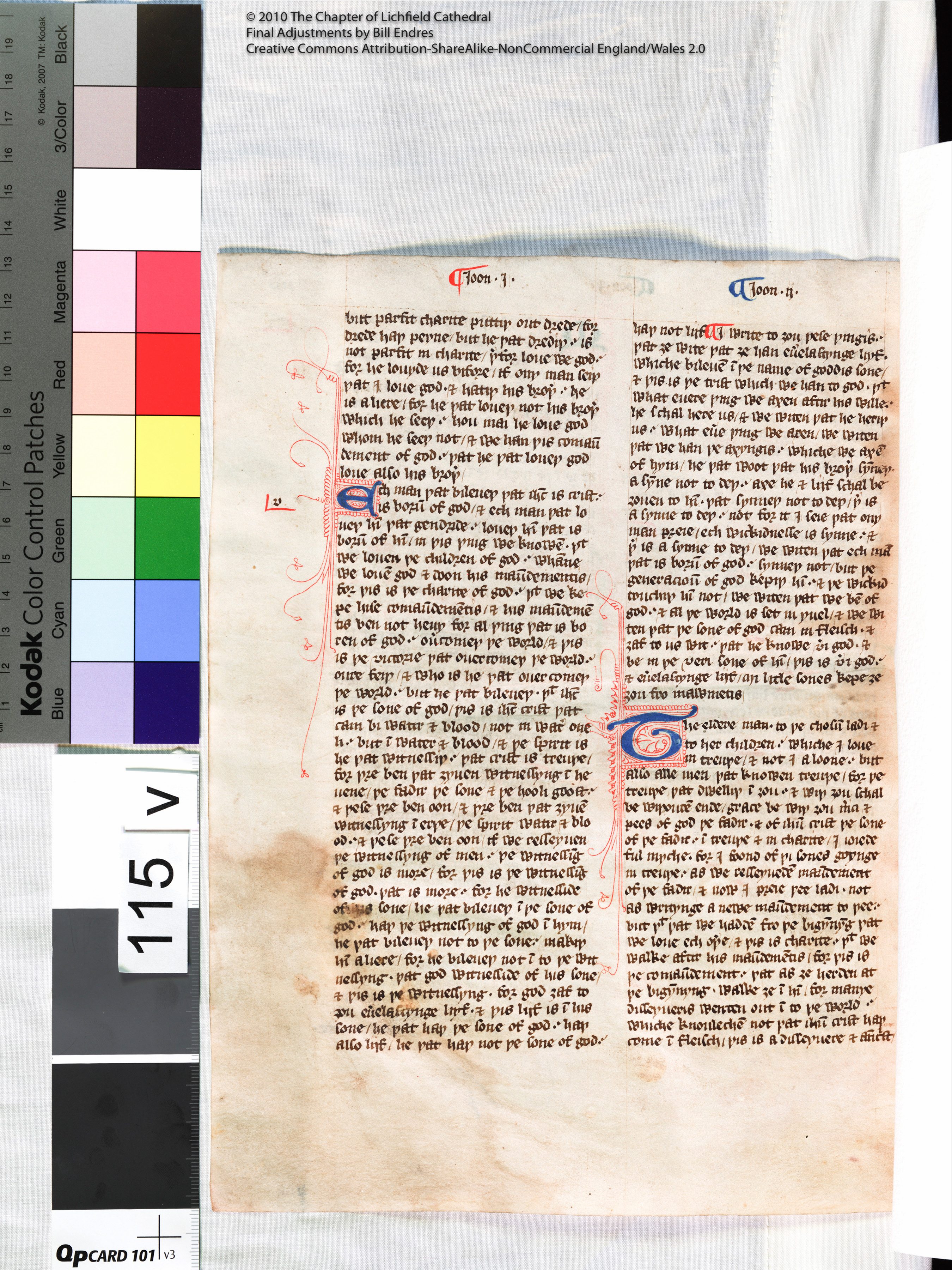
- c. 1395, John Wycliffe, John Purvey [et al.], transl., Bible (Wycliffite Bible (later version), MS Lich 10.)[5], published c. 1410, Joon ·i· 5:3, folio 115, verso, column 1; republished as Wycliffe's translation of the New Testament, Lichfield: Bill Endres, 2010:
- foꝛ þis is þe charite of god .· þat we kepe hiſe comaundementis / ⁊ his maundementis ben not heuy.
- Now this is the love of God: us keeping his commandments. And his commandments aren't onerous.
Descendants
References
- “not, adv.”, in MED Online, Ann Arbor, Mich.: University of Michigan, 2007.
Noun
not (uncountable)
Descendants
References
- “not, pron.”, in MED Online, Ann Arbor, Mich.: University of Michigan, 2007.
Etymology 2
From Old English nāt, first and third person singular of nitan, equivalent to ne + woot and ne + witen.
Alternative forms
Pronunciation
- IPA(key): /nɔːt/, /naːt/
Contraction
not
- contraction of ne + woot, literally “not to know”.
- 1387–1400, Geoffrey Chaucer, “(please specify the story via the 'title' parameter)”, in The Canterbury Tales, [Westminster: William Caxton, published 1478], →OCLC; republished in [William Thynne], editor, The Workes of Geffray Chaucer Newlye Printed, […], [London]: […] [Richard Grafton for] Iohn Reynes […], 1542, →OCLC:
- I noot which was the fairer of hem two
- (please add an English translation of this quotation)
Related terms
Descendants
- Yola: note
References
- “witen, v.(1)”, in MED Online, Ann Arbor, Mich.: University of Michigan, 2007.
Norwegian Nynorsk
Alternative forms
- nót (alternative spelling of etymology 1 and 2)
Pronunciation
- IPA(key): /nuːt/
Etymology 1
From Old Norse nót, from Proto-Germanic *nōtō (“net; seine”).
Noun
not f (definite singular nota, indefinite plural nøter, definite plural nøtene)
Derived terms
- dragnot
- flytenot
- fløytnot
- kastenot
- kilenot
- laksenot
- landnot
- notbas
- notbruk
- notfiske
- nothund
- notlag
- notnål
- notsteng
- notvarp
- posenot
- ringnot
- sildenot
- slepenot
- snurpenot
Etymology 2
From Middle Low German.
Noun
not f (definite singular nota, indefinite plural noter, definite plural notene)
- (carpentry, mechanics) a groove (as used in a tongue and groove joint)
- Coordinate term: fjør
Derived terms
- nothøvel
Etymology 3
Noun
not f (definite singular nota, indefinite plural neter, definite plural netene)
- (pre-2012) alternative form of nøtt (“nut”)
References
- “not” in The Nynorsk Dictionary.
Anagrams
Old Dutch
Etymology
From Proto-West Germanic *naudi, from Proto-Germanic *naudiz.
Noun
nōt f
Inflection
Derived terms
- ginōdi
Descendants
- Middle Dutch: nôot
References
- “nōt”, in Oudnederlands Woordenboek, 2012
Old English
Alternative forms
- nōt
Etymology
Pronunciation
- IPA(key): /not/
- Rhymes: -ot
Noun
not m (nominative plural notas)
Declension
Strong a-stem:
| singular | plural | |
|---|---|---|
| nominative | not | notas |
| accusative | not | notas |
| genitive | notes | nota |
| dative | note | notum |
Descendants
Old High German
Alternative forms
Etymology
Inherited from Proto-West Germanic *naudi
Noun
nōt m
- control (by violence), compulsion, coercion, extortion
- distress, danger, crisis, both physical and psychological
- need, (urgent) necessity
- inevitability
- force, violence, bluster
Derived terms
- ginōt f
- ginōti (adjective)
- ginōtmarkunga f
- ginōtmarkōn (verb)
- ginōtmez n
- ginōtmezzunga f
- ginōtmezzōn (verb)
- nôtsamanunga f
- nōtag (adjective)
- nōtdwingāri m
- nōten (verb)
- nōtfesti (adjective)
- nōtfolgunga f
- nōtfolgīg (adjective)
- nōtfriunt m
- nōtgistallo m
- nōthaft (adjective)
- nōtlīh (adverb)
- nōtmahhunga f
- nōtmahhīg (adjective)
- nōtmeior m
- nōtmez n
- nōtmezzōn (verb)
- nōtnemo m
- nōtnemāri m
- nōtnumft f
- nōtnumftlīhho (adverb)
- nōtnumftāri m
- nōtnumftīg (adjective)
- nōtnumftīgo (adverb)
- nōtnumftīgī f
- nōtnumo m
- nōtnāma f
- nōto (adverb)
- nōtstallo m
- nōtsuoh m
- nōtsuohhâri m
- nōtsuohhōn (verb)
- nōtsuona f
- nōttāt f
- nōtweg m
- nōtwegida f
- nōtwerk n
- nōtzogōn (verb)
- nōtēn (verb)
- nōtīg (adjective)
References
- Karg-Gasterstädt, Elisabeth; Frings, Theodor; et al., editors (1952–2022), “nôt”, in Althochdeutsches Wörterbuch[6] (in German), Berlin: Akademie-Verlag, via Sächsische Akademie der Wissenschaften zu Leipzig
Old Irish
Etymology
From Proto-Brythonic *nod (compare Middle Welsh not, Welsh nod), from Latin nota.
Noun
not f
- mark, sign (in writing)
- scribal abbreviation
Descendants
Further reading
- Gregory Toner, Sharon Arbuthnot, Máire Ní Mhaonaigh, Marie-Luise Theuerkauf, Dagmar Wodtko, editors (2019), “not, nod”, in eDIL: Electronic Dictionary of the Irish Language
Old Saxon
Etymology
From Proto-West Germanic *naut, from Proto-Germanic *nautą. Cognate with Old English neat, Old Frisian nāt, Dutch noot, Old High German nōz (dialectal German Nos), Old Norse naut.
Noun
nōt n
Declension
| singular | plural | |
|---|---|---|
| nominative | nōt | nōt |
| accusative | nōt | nōt |
| genitive | nōtes | nōtō |
| dative | nōte | nōtun |
| instrumental | — | — |
Descendants
Old Swedish
Etymology
From Old Norse nót, from Proto-Germanic *nōtō.
Pronunciation
- IPA(key): /noːt/
Noun
nōt f
Declension
| masculine | singular | plural | ||
|---|---|---|---|---|
| indefinite | definite | indefinite | definite | |
| nominative | nōt | nōtin | nōtar | nōtarnar, nōtanar |
| accusative | nōt | nōtina | nōtar | nōtarnar, nōtanar |
| dative | nōt, nōto | nōtinni, nōtinne | nōtum, nōtom | nōtumin, nōtomen |
| genitive | nōtar | nōtarinnar | nōta | nōtanna |
Descendants
- Swedish: not
Romansh
Alternative forms
Etymology
Inherited from Latin nox, from Proto-Italic *nokts, from Proto-Indo-European *nókʷts.
Noun
not f (plural nots)
Scottish Gaelic
Etymology
Borrowed from English note. The "money" sense comes from the now-rare £1 note.
Pronunciation
Noun
not m (genitive singular not, plural notaichean)
References
- ^ Oftedal, M. (1956), A linguistic survey of the Gaelic dialects of Scotland, Vol. III: The Gaelic of Leurbost, Isle of Lewis, Oslo: Norsk Tidsskrift for Sprogvidenskap
Swedish
Etymology 1
From Old French note (noun), noter (verb), both from Latin nota.
Pronunciation
- IPA(key): /ˈnuːt/
Noun
not c
- (music) note.
- a short message; note.
- (diplomacy) a formal message from a country to another country’s embassy.
Declension
| nominative | genitive | ||
|---|---|---|---|
| singular | indefinite | not | nots |
| definite | noten | notens | |
| plural | indefinite | noter | noters |
| definite | noterna | noternas |
Derived terms
Related terms
Etymology 2
From Old Swedish nōt, from Old Norse nót, from Proto-Germanic *nōtō. Related to nät (“net”).
Noun
not c
Declension
| nominative | genitive | ||
|---|---|---|---|
| singular | indefinite | not | nots |
| definite | noten | notens | |
| plural | indefinite | notar | notars |
| definite | notarna | notarnas |
Etymology 3
From Low German not, nut. Cognate with German Nut.
Noun
not c
Declension
| nominative | genitive | ||
|---|---|---|---|
| singular | indefinite | not | nots |
| definite | noten | notens | |
| plural | indefinite | notar | notars |
| definite | notarna | notarnas |
Anagrams
Tok Pisin
Etymology
Noun
not
Turkish
Etymology
Pronunciation
- IPA(key): /ˈnot/
- Rhymes: -ot
Noun
not (definite accusative notu, plural notlar)
Declension
| singular | plural | |
|---|---|---|
| nominative | not | notlar |
| definite accusative | notu | notları |
| dative | nota | notlara |
| locative | notta | notlarda |
| ablative | nottan | notlardan |
| genitive | notun | notların |
Welsh
Pronunciation
- IPA(key): /nɔt/
Etymology 1
Noun
not m (plural notiau, not mutable)
Etymology 2
Noun
not
- nasal mutation of dot