mur
Aromanian • Asturian • Breton • Catalan • Cimbrian • Dalmatian • Danish • Franco-Provençal • French • Gavak • Hausa • Indonesian • Irish • Ladino • Leonese • Livonian • Lolopo • Lombard • Malay • Middle French • Middle Low German • Norman • Norwegian Bokmål • Norwegian Nynorsk • Occitan • Old English • Old French • Old Galician-Portuguese • Old Spanish • Piedmontese • Polish • Romanian • Scottish Gaelic • Spanish • Sumerian • Swedish • Tolai • Welsh
Page categories
Translingual
Symbol
mur
See also
- Wiktionary’s coverage of Murle terms
Aromanian
Etymology
Inherited from Latin mūrus, from Old Latin *moerus, *moiros, from Proto-Indo-European *mey- (“to strengthen”).
Pronunciation
- IPA(key): /mur/
Noun
mur m (plural muri)
Related terms
- murisci
Asturian
Alternative forms
Etymology
From Latin mūrem, accusative singular of mus, from Proto-Indo-European *muh₂s.
Pronunciation
- IPA(key): /ˈmuɾ/ [ˈmuɾ]
- Rhymes: -uɾ
- Syllabification: mur
Noun
mur m (plural mures)
Further reading
- Xosé Lluis García Arias (2002–2004), “mur”, in Diccionario general de la lengua asturiana [General Dictionary of the Asturian Language] (in Spanish), Editorial Prensa Asturiana, →ISBN
- “mur”, in Diccionariu de la llingua asturiana [Dictionary of the Asturian Language] (in Asturian), 1st edition, Academy of the Asturian Language [Asturian: Academia de la Llingua Asturiana], 2000, →ISBN
Breton
Etymology
From Middle Breton mur, from Old Breton mur, from Proto-Brythonic *mʉr, from Latin mūrus.
Pronunciation
- IPA(key): [ˈmyːr]
Noun
mur f (plural murioù)
References
- Cornillet, Gérard (2017), “mur”, in Geriadur galleg brezhoneg, dictionnaire français breton[1] (in French), page 947
- Martial Menard, editor (2016–present), “mur”, in Devri: Le dictionnaire diachronique du breton[2] (in French), Rennes 2 University
Catalan
Etymology
Inherited from Old Catalan mur, from Latin mūrus, from Old Latin *moerus, *moiros, from Proto-Indo-European *mey- (“to strengthen”).
Pronunciation
Noun
mur m (plural murs)
Derived terms
Related terms
Further reading
- “mur”, in Diccionari de la llengua catalana [Dictionary of the Catalan Language] (in Catalan), second edition, Institute of Catalan Studies [Catalan: Institut d'Estudis Catalans], April 2007
- “mur”, in Gran Diccionari de la Llengua Catalana, Grup Enciclopèdia Catalana, 2026
- “mur” in Diccionari normatiu valencià, Acadèmia Valenciana de la Llengua.
- Alcover, Antoni Maria; Moll, Francesc de Borja (1963), “mur”, in Diccionari català-valencià-balear (in Catalan)
Cimbrian
Etymology
Probably ultimately from Latin morus; cf. Italian mora, moro.
Noun
mur f
References
- Umberto Patuzzi, ed., (2013) Ünsarne Börtar, Luserna: Comitato unitario delle linguistiche storiche germaniche in Italia / Einheitskomitee der historischen deutschen Sprachinseln in Italien
Dalmatian
Etymology
From Latin mare, from Proto-Italic *mari, from Proto-Indo-European *móri.
Noun
mur
Danish
Pronunciation
- IPA(key): /ˈmuːˀr/, [ˈmuˀɐ̯], [ˈmuɐ̯ˀ]
- Rhymes: -ur
Etymology 1
From Old Norse múrr m, borrowed via Old English mūr or Old Saxon mūr from Latin mūrus. Compare also German Mauer f, Dutch muur m.
Noun
mur c (singular definite muren, plural indefinite mure)
- wall (defence structure)
- wall (a wall-like structure built by overlapping bricks or by stones)
- (soccer) wall
- Coordinate terms: blokade, opdækning
Declension
| common gender |
singular | plural | ||
|---|---|---|---|---|
| indefinite | definite | indefinite | definite | |
| nominative | mur | muren | mure | murene |
| genitive | murs | murens | mures | murenes |
Derived terms
See also
Etymology 2
See the etymology of the corresponding lemma form.
Verb
mur
- imperative of mure
References
- “mur” in Den Danske Ordbog
Franco-Provençal
Etymology
Noun
mur m (plural murs) (ORB, broad)
References
- mur in DicoFranPro: Dictionnaire Français/Francoprovençal – on dicofranpro.llm.umontreal.ca
- mur in Lo trèsor Arpitan – on arpitan.eu
French
Etymology
Inherited from Middle French mur, from Old French mur, from Latin mūrus, from Old Latin *moerus, *moiros, from Proto-Italic *moiros, from Proto-Indo-European *mey- (“to strengthen”).
Pronunciation
- IPA(key): /myʁ/
Audio; “un mur”: (file) Audio (Canada (Shawinigan)): (file) Audio (Switzerland (Valais)): (file) Audio (France (Toulouse)): (file) Audio (France (Vosges)): (file) Audio (France (Vosges)): (file) Audio (France (Lyon)): (file) Audio (France (Somain)): (file) - Rhymes: -yʁ
- Homophones: mûr, murs, mûrs, mure, mûre, mures, mûres, murent
Noun
mur m (plural murs)
Derived terms
Descendants
- Haitian Creole: mi
See also
Further reading
- “mur”, in Trésor de la langue française informatisé [Digitized Treasury of the French Language], 2012
Gavak
Noun
mur
References
- Pick, Andrew (2019), “Yamben: A previously undocumented language of Madang”, in 5th Workshop on the Languages of Papua[3], Universitas Negeri Papua, Manokwari, West Papua, Indonesia
Hausa
Etymology
Borrowing from Arabic مُرّ (murr).
Pronunciation
Noun
mûr̃ m
Indonesian
Etymology
From Dutch moer, a shortening of moerschroef, from moer (“mother”) + schroef (“bolt”).
Pronunciation
- IPA(key): /mur/
Noun
mur (plural mur-mur)
- nut (fastener for a bolt)
Irish
Pronunciation
Determiner
mur
References
- ^ Quiggin, E. C. (1906), A Dialect of Donegal, Cambridge University Press, § 235, page 86

Ladino
Alternative forms
Etymology
Borrowed from Ottoman Turkish مهر.
Noun
mur m (Hebrew spelling מור)[1]
- seal (sigil or seal ring)
- postage stamp
- Vó a pozar un mur para la karta de korreo.
- I am going to put a stamp on the postcard.
References
Leonese
Etymology
(This etymology is missing or incomplete. Please add to it, or discuss it at the Etymology scriptorium.)
Noun
mur m (plural mures)
References
- “mur”, in Diccionario Castellano-Leonés / Leonés-Castellano [Spanish-Leonese / Leonese-Spanish Dictionary] (in Spanish), La Asociación L'Alderique, 2012–2026
Livonian
Alternative forms
- mur (Salaca)
Etymology
From Proto-Finnic *murëh. Cognate with Estonian mure, Finnish murhe.
Pronunciation
- IPA(key): /ˈmuˀr/, [ˈmuˀr]
Noun
mu’r
Declension
| singular (ikšlu’g) | plural (pǟgiņlu’g) | |
|---|---|---|
| nominative (nominatīv) | mu’r | murūd |
| genitive (genitīv) | mu’r | murūd |
| partitive (partitīv) | mu’rtõ | murīdi |
| dative (datīv) | mu’rrõn | murūdõn |
| instrumental (instrumentāl) | mu’rkõks | murūdõks |
| illative (illatīv) | mu’rrõ | murīž |
| inessive (inesīv) | mu’rsõ | mu’rši |
| elative (elatīv) | mu’rstõ | mu’ršti |
References
- Tiit-Rein Viitso; Valts Ernštreits (2012–2013), “mu’r”, in Līvõkīel-ēstikīel-lețkīel sõnārōntõz [Livonian-Estonian-Latvian Dictionary][4] (in Estonian and Latvian), Tartu, Rīga: Tartu Ülikool, Latviešu valodas aģentūra
Lolopo
Etymology
From Proto-Loloish *mraŋ² (Bradley). Cognate with Nuosu ꃅ (mu), Burmese မြင်း (mrang:).
Pronunciation
- IPA(key): [mɤ²¹]
Noun
mur
- (Yao'an) horse
Lombard
Etymology
From Latin mūrus, from Proto-Italic *moiros, from Proto-Indo-European *mey- (“to strengthen”).
Pronunciation
Noun
mur m
Malay
Etymology
Apocopic form of murah
Adjective
mur (comparative lebih mur, superlative paling mur)
- (slang) alternative form of murah
Middle French
Etymology
From Old French mur, from Latin mūrus, from Old Latin *moerus, *moiros, from Proto-Italic *moiros, from Proto-Indo-European *mey- (“to strengthen”).
Noun
mur m (plural murs)
Descendants
- French: mur
References
- mur on Dictionnaire du Moyen Français (1330–1500) (in French)
Middle Low German
Noun
mur or mür f
- alternative form of mure
Norman
Etymology
From Old French mur, from Latin mūrus, from Old Latin *moerus, *moiros, from Proto-Indo-European *mei (“to fix, to build fortifications or fences”).
Noun
mur m (plural murs)
Synonyms
- muthâle (Jersey)
Norwegian Bokmål
Etymology
From Old Norse múrr, from Latin murus.
Noun
mur m (definite singular muren, indefinite plural murer, definite plural murene)
- a wall (a free-standing barrier, typically made of bricks, stone or concrete)
- En vegg av tre er mindre solid enn en mur av stein.
- A wall made of wood is less solid than a wall made of stone.
Usage notes
Norwegian uses two different words for "wall". One, "mur", refers to independent outdoor structures used to fortify and delineate. The other, "vegg", is used to refer to the walls of a building, regardless of its location and material composition. Both are occasionally used metaphorically, "mur" more so. "Mur" can also refer to the type of material such walls are typically made of, hence the possible construction "murvegg", meaning the wall of a house composed of brick or concrete.
Derived terms
References
- “mur” in The Bokmål Dictionary.
Norwegian Nynorsk
Etymology
From Old Norse múrr, from Latin murus.
Pronunciation
- IPA(key): /mʉːr/
Noun
mur m (definite singular muren, indefinite plural murar, definite plural murane)
- a wall (of stone, concrete or similar material)
- Ein vegg av tre er mindre solid enn ein mur av stein.
- A wall made of wood is less solid than a wall made of stone.
Usage notes
- The words mur and vegg are both translated into English as wall. However, they are widely distinguished in the following manner: only mur is commonly used for freestanding walls. Only vegg is commonly used for the walls of a building, whether internal or external. Mur is restricted to stone or concrete walls, whereas vegg is used regardless of material. A wall made from brick or stone can be called a murvegg.
Derived terms
References
- “mur” in The Nynorsk Dictionary.
Occitan
Alternative forms
Etymology
From Old Occitan mur, from Latin mūrus, from Old Latin *moerus, *moiros, from Proto-Indo-European *mei (“to fix, to build fortifications or fences”).
Pronunciation
Noun
mur m (plural murs)
Old English
Etymology
From Proto-West Germanic *mūrā, borrowed from Latin mūrus.
Pronunciation
- IPA(key): /muːr/
- Rhymes: -uːr
Noun
mūr m
Declension
Weak:
| singular | plural | |
|---|---|---|
| nominative | mūra | mūran |
| accusative | mūran | mūran |
| genitive | mūran | mūrena |
| dative | mūran | mūrum |
References
- Joseph Bosworth; T. Northcote Toller (1898), “múr”, in An Anglo-Saxon Dictionary, second edition, Oxford: Oxford University Press.
Old French
Etymology
From Latin mūrum, accusative singular of mūrus, from Old Latin *moerus, *moiros, from Proto-Italic *moiros, from Proto-Indo-European *mei (“to fix, to build fortifications or fences”).
Noun
mur oblique singular, m (oblique plural murs, nominative singular murs, nominative plural mur)
Descendants
Old Galician-Portuguese
Etymology
From Latin mūrem, accusative singular of mus.
Pronunciation
- IPA(key): /ˈmuɾ/
Noun
mur m (plural murs)
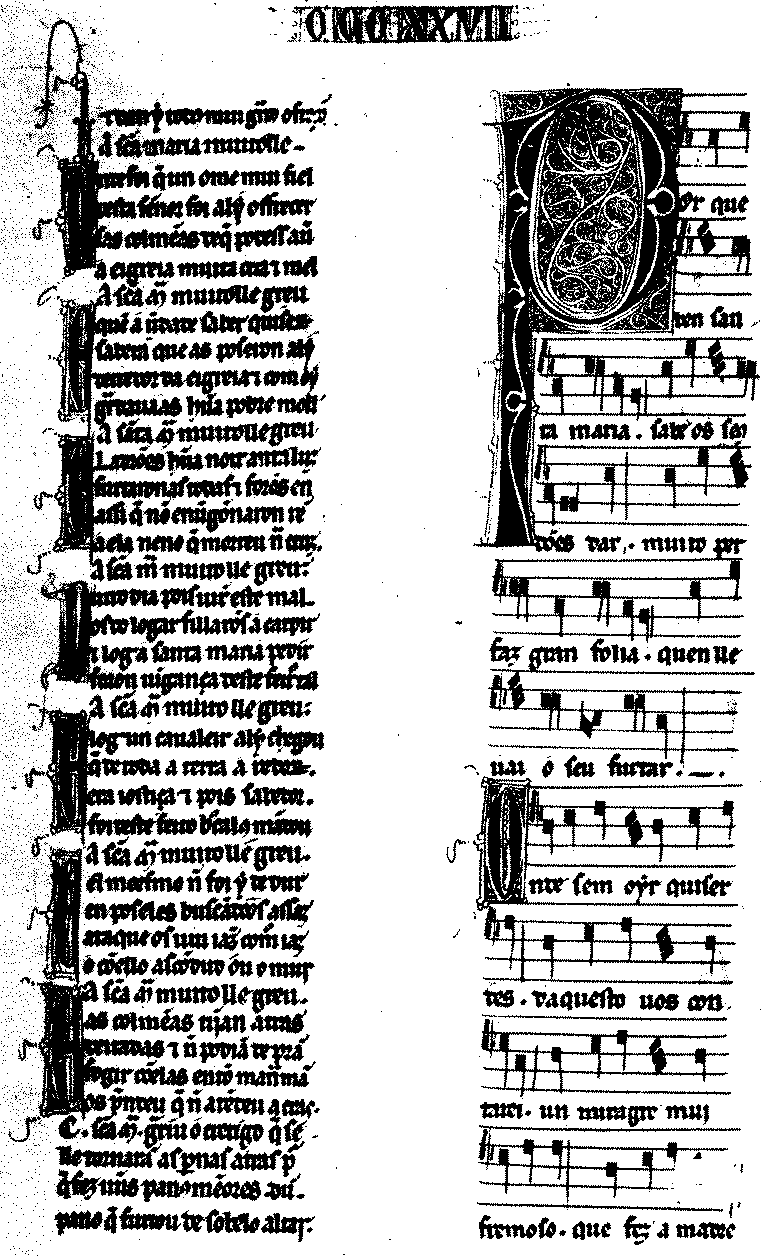
- A mouse or rat
- a. 1284, Alfonso X of Castile, Cantigas de Santa Maria, Códice de los músicos, cantiga 326 (facsimile):
- oſ uiu iaz(er) com(o) iaz / o cõello aſcõdud ou o mur
- he saw them hiding like a cowering rabbit or a mouse.
- oſ uiu iaz(er) com(o) iaz / o cõello aſcõdud ou o mur
Descendants
Old Spanish
Etymology
From Latin mūrem, accusative singular of mūs.
Noun
mur m
- mouse
- 1251, anonymous, Calila e Dimna 14, (ed. by Juan Manuel Cacho Blecua, María Jesús Lacarra, Madrid: Castalia, 1993):
- Et alçó los ojos contra las dos ramas et vio estar en las raízes dellas dos mures, el uno blanco et el otro negro, royendo sienpre, que non quedavan.
- And he raised his eyes towards the two branches [he was hanging on from], and saw that at the roots there were two mice, one white and the other black, constantly gnawing to the point there hardly remained any roots anymore.
- Et alçó los ojos contra las dos ramas et vio estar en las raízes dellas dos mures, el uno blanco et el otro negro, royendo sienpre, que non quedavan.
Piedmontese
Etymology
From Latin mūrum, accusative singular of mūrus.
Pronunciation
- IPA(key): /myr/
Noun
mur m
Derived terms
- muraja
- murèt
Polish
Etymology
Borrowed from Latin mūrus (“wall”).
Pronunciation
- IPA(key): /ˈmur/
Audio: (file) - Rhymes: -ur
- Syllabification: mur
- Homophone: mór
Noun
mur m inan (diminutive murek)
- wall (defensive rampart)
- Synonym: wał
- wall (structure built for defense surrounding an area)
- Synonym: wał
Declension
Derived terms
Related terms
- murarski
- murowy
- murować
- wmurować
- wmurowywać
- wymurować
- wymurowywać
- zamurować
- zamurowywać
Descendants
Further reading
- “mur”, in Wielki słownik języka polskiego[5] (in Polish), Instytut Języka Polskiego PAN
- “mur”, in Polish dictionaries at PWN[6] (in Polish)
Romanian
Pronunciation
- IPA(key): /mur/
Etymology 1
Inherited from Latin mōrus, from Ancient Greek μόρον (móron).
Noun
mur m (plural muri)
- blackberry bush
Declension
| singular | plural | |||
|---|---|---|---|---|
| indefinite | definite | indefinite | definite | |
| nominative-accusative | mur | murul | muri | murii |
| genitive-dative | mur | murului | muri | murilor |
| vocative | murule | murilor | ||
Related terms
Etymology 2
Borrowed from Latin mūrus (19th century).[1] Perhaps preserved as popular in its use as a rare regionalism from Maramureș and Ardeal.[2]
Noun
mur m (plural muri)
Declension
| singular | plural | |||
|---|---|---|---|---|
| indefinite | definite | indefinite | definite | |
| nominative-accusative | mur | murul | muri | murii |
| genitive-dative | mur | murului | muri | murilor |
| vocative | murule | murilor | ||
References
- ^ “mur”, in DEX online—Dicționare ale limbii române (Dictionaries of the Romanian language) (in Romanian), 2004–2026
- ^ Dictionary of Regionalisms and Archaisms from Maramureș.https://ro.wikisource.org/wiki/Dic%C8%9Bionar_de_regionalisme_%C8%99i_arhaisme_din_Maramure%C8%99/Litera_M
Scottish Gaelic
Conjunction
mur
- alternative form of mura
Spanish
Etymology
Inherited from Old Spanish mur, from Latin mūrem. Displaced by ratón, an augmentative form of rata (“rat”).
Pronunciation
- IPA(key): /ˈmuɾ/ [ˈmuɾ]
- Rhymes: -uɾ
- Syllabification: mur
Noun
mur m (plural mures)
Related terms
Further reading
- “mur”, in Diccionario de la lengua española [Dictionary of the Spanish Language] (in Spanish), online version 23.8.1, Royal Spanish Academy [Spanish: Real Academia Española], 15 December 2025
Sumerian
Romanization
mur
- romanization of 𒄯 (mur)
Swedish
Etymology
From Old Swedish mur, from Latin murus, possibly through an intermediate like Middle Low German mûre.
Pronunciation
- IPA(key): /ˈmʉːr/
Audio (Gotland); “en mur”: (file) - Rhymes: -ʉːr
Noun
mur c
- a (usually free-standing) wall built of overlapping bricks or stones or cement or the like
- Berlinmuren
- the Berlin Wall
- kinesiska muren
- the Great Wall of China
- Hadrianus mur
- Hadrian's Wall
- a wall (defensive structure surrounding a city, castle, etc.)
- (uncountable) the type of material such a wall is made of, usually brick (including when not making up a free-standing wall)
- Vi gjorde ett hål i rummets trävägg och såg att det var mur innanför
- We made a hole in the wooden wall of the room and saw that there was brick behind it
- (soccer) a wall
Usage notes
An inner or outer wall of a building is a vägg. More rarely, mur might refer to a vägg made of brick or the like. Other terms for such a vägg is murvägg or murad vägg.
Declension
| nominative | genitive | ||
|---|---|---|---|
| singular | indefinite | mur | murs |
| definite | muren | murens | |
| plural | indefinite | murar | murars |
| definite | murarna | murarnas |
Derived terms
- murbruk (“mortar”)
- murgröna (“common ivy”)
- ringmur (“city wall”)
- stadsmur (“city wall”)
- tiga som muren
Related terms
Descendants
- → Finnish: muuri
See also
References
- “mur”, in Svensk ordbok [Dictionary of Swedish] (in Swedish)
- “mur”, in Svenska Akademiens ordlista [Wordlist of the Swedish Academy] (in Swedish)
- “mur”, in Svenska Akademiens ordbok [Dictionary of the Swedish Academy] (in Swedish)
Anagrams
Tolai
Alternative forms
Pronoun
mur
- Second-person dual pronoun: you two
Declension
| singular | dual | paucal | plural | |
|---|---|---|---|---|
| 1st person exclusive |
iau | amir mir |
amital mital |
avet ave1 |
| 1st person inclusive |
- | dor | datal | dat da1 |
| 2nd person | u | amur mur |
amutal mutal |
avat ava1 |
| 3rd person | ia i |
dir di |
dital | diat dia1 |
1) The plural pronouns lose the final -t when preceding a verb.
Welsh
Etymology
From Middle Welsh mur, from Old Welsh mur, from Proto-Brythonic *mʉr, from Latin mūrus.
Pronunciation
- (North Wales) IPA(key): /mɨːr/
- (South Wales) IPA(key): /miːr/
- Rhymes: -ɨːr
- Homophone: mŷr; mir (South Wales)
Noun
mur m (plural muriau)
Usage notes
The most commonly used word for “wall” in Welsh is wal. The word mur is used most often when referring to large walls such as the defensive walls of a city or Mur Mawr Tsieina (“the Great Wall of China”). It is also used in compound words, for example murlun, rhagfur, cellfur, briwydd y mur. The word pared refers to an internal partition wall whereas magwyr is a literary word for an external wall, little used now but preserved in such things as place and plant names.
Derived terms
- briwydd y mur (“wall bedstraw”)
- carreg ben mur
- cellfur (“cell wall”)
- cenllys y muriau
- craidd mur
- creigafal y mur (“wall cotoneaster”)
- chwerwlys y mur
- dringwr muriau
- duegredyn y muriau (“wall-rue”)
- haidd y mur
- llysiau'r-bystwn y muriau
- Mur Antwn (“the Antonine Wall”)
- Mur Hadrian (“Hadrian's Wall”)
- Mur Mawr Tsieina (“the Great Wall of China”)
- Mur Wylofain (“the Wailing Wall”)
- murio
- muriog
- murlen
- murlun (“mural”)
- murol
- rhagfur (“bulwark, rampart”)