dub
Translingual
Etymology
Clipping of English Dubli.
Symbol
dub
See also
- Wiktionary’s coverage of Dubli terms
English
Pronunciation
- (Received Pronunciation, General American, Canada) IPA(key): /dʌb/
- (General Australian, New Zealand) IPA(key): /dɐb/
Audio (Queensland): (file)
- (Northern England, Ireland) IPA(key): /dʊb/
- Rhymes: -ʌb
Etymology 1
From Middle English dubben, from Old English dubbian (“to knight by striking with a sword, dub”) from Old French adober (“to equip with arms; adorn”) (also 11th century, Modern French adouber), both from Proto-West Germanic *dubbōn, from Proto-Germanic *dub- (“to hit, strike”), from Proto-Indo-European *dʰewbʰ- (“plug, peg, wedge”).
Cognate with Icelandic dubba (in dubba til riddara). Compare also drub for an English reflex of the Germanic word.
Verb
dub (third-person singular simple present dubs, present participle dubbing, simple past and past participle dubbed)
- (transitive, now historical or ceremonial) To confer knighthood; the conclusion of the ceremony was marked by a tap on the shoulder with a sword, the accolade.
- Synonym: knight
- c. 1591–1592 (date written), William Shakespeare, “The Third Part of Henry the Sixt, […]”, in Mr. William Shakespeares Comedies, Histories, & Tragedies […] (First Folio), London: […] Isaac Iaggard, and Ed[ward] Blount, published 1623, →OCLC, [Act II, scene ii], page 154, column 2:
- You promiſt Knighthood to our forward ſonne, / Vnſheath your ſword, and dub him preſently.
- 1885, Miguel de Cervantes Saavedra, chapter II, in John Ormsby, transl., The Ingenious Gentleman Don Quixote of La Mancha […] In Four Vols, volume I, London: Smith, Elder & Co. […], →OCLC, part I, page 114:
- It occurred to him that he had not been dubbed a knight, and that according to the law of chivalry he neither could nor ought to bear arms against any knight; […] .
- (transitive, now informal) To name, to entitle, to call. [from the later 16th c.]
- Synonyms: designate, name; see also Thesaurus:denominate
- 1876, Mark Twain [pseudonym; Samuel Langhorne Clemens], The Adventures of Tom Sawyer, Hartford, Conn.: The American Publishing Company, →OCLC:
- They tripped along the murky aisles with the rest of the company, visiting the familiar wonders of the cave—wonders dubbed with rather over-descriptive names, such as “The Drawing-Room,” “The Cathedral,” Aladdin’s Palace,” and so on.
- 1907 August, Robert W[illiam] Chambers, chapter V, in The Younger Set, New York, N.Y.: D. Appleton & Company, →OCLC:
- As a matter of fact its narrow ornate façade presented not a single quiet space that the eyes might rest on after a tiring attempt to follow and codify the arabesques, foliations, and intricate vermiculations of what some disrespectfully dubbed as “near-aissance.”
- 2013 June 22, “Engineers of a different kind”, in The Economist[1], volume 407, number 8841, archived from the original on 31 October 2020, page 70:
- Private-equity nabobs bristle at being dubbed mere financiers. Piling debt onto companies’ balance-sheets is only a small part of what leveraged buy-outs are about, they insist. Improving the workings of the businesses they take over is just as core to their calling, if not more so. Much of their pleading is public-relations bluster.
- 2023 December 27, Stephen Roberts, “Bradshaw's Britain: the way to Weymouth”, in RAIL, number 999, page 52:
- Stephen reigned from 1135-1154, that nasty period of our history dubbed 'The Anarchy', when forces loyal to Stephen contested the throne with those of Henry I's daughter Matilda, who by rights should have been queen. Stephen, her cousin, plonked his own posterior on the throne.
- (transitive) To deem.
- Synonyms: consider, think of; see also Thesaurus:deem
- 1733–1737, Alexander Pope, [Imitations of Horace], London: […] R[obert] Dodsley [et al.]:
- A man of wealth is dubbed a man of worth.
- To clothe or invest; to ornament; to adorn.
- Synonyms: deck out, embellish; see also Thesaurus:decorate
- 1470–1485 (date produced), Thomas Malory, “(please specify the chapter)”, in [Le Morte Darthur], (please specify the book number), [London: […] by William Caxton], published 31 July 1485, →OCLC; republished as H[einrich] Oskar Sommer, editor, Le Morte Darthur […], London: David Nutt, […], 1889, →OCLC:
- His diadem was dropped down / Dubbed with stones.
- (please add an English translation of this quotation)
- (heading) To strike, rub, or dress smooth; to dab.
- To dress with an adze.
- to dub a stick of timber smooth
- To strike cloth with teasels to raise a nap.
- 1808, Annual Register:
- For dressing or dubbing cloths, either wet or dry, otherwise than by green cards and pickards
- To rub or dress with grease, as leather in the process of currying it.
- 1852-1866, Charles Tomlinson, Cyclopaedia of Useful Arts and Manufactures
- When the skin is thoroughly cleansed, and while yet in its wet and distended state, the process of stuffing, or dubbing (probably a corruption of daubing), is performed. Both sides of the skin, but chiefly the flesh side, are smeared or daubed with a mixture of cod-oil and tallow
- 1852-1866, Charles Tomlinson, Cyclopaedia of Useful Arts and Manufactures
- To dress a fishing fly.
- 1689, James Chetham, The Anglers Vade Mecum:
- if you can dub a Fly of the exact colour of the Natural Fly, Fish at that instant take, it's sufficient
- To dress with an adze.
- To prepare (a gamecock) for fighting, by trimming the hackles and cutting off the comb and wattles.
Derived terms
Translations
|
|
Etymology 2
1505-1515 This etymology is incomplete. You can help Wiktionary by elaborating on the origins of this term.
Verb
dub (third-person singular simple present dubs, present participle dubbing, simple past and past participle dubbed)
- To make a noise by brisk drumbeats.
- 1616–1619 (first performance), John Fletcher, “The Mad Lover”, in Comedies and Tragedies […], London: […] Humphrey Robinson, […], and for Humphrey Moseley […], published 1647, →OCLC, Act I, scene i:
- Now the drum dubb's.
- To do something badly.
- (golf) To execute a shot poorly.
Noun
dub (plural dubs)
- (rare) A blow, thrust, or poke.
- 1662 (indicated as 1663), [Samuel Butler], “[The First Part of Hudibras]”, in Hudibras. The First and Second Parts. […], London: […] John Martyn and Henry Herringman, […], published 1678; republished in A[lfred] R[ayney] Waller, editor, Hudibras: Written in the Time of the Late Wars, Cambridge, Cambridgeshire: University Press, 1905, →OCLC:
- And kettle-drums, whose sullen dub
Sounds like the hooping of a tub
- (golf) A poorly executed shot.
Etymology 3
1885-90. Imitative; see also flub, flubdub.
Noun
dub (plural dubs)
- (slang, now historical) An unskillful, awkward person. [from the later part of the 19th c]
- 1936, P. G. Wodehouse, There's Always Golf[2], London: The Strand Magazine:
- As I came over the hill, I saw Ernest Plinlimmon and his partner, in whom I recognized a prominent local dub, emerging from the rough on the right. Apparently, the latter had sliced from the tee, and Ernest had been helping him find his ball.
- 1969, Robert L. Vann, The Competitor, volumes 2-3, page 135:
- The miser, a-seeking lost gelt, / The doughboy, awaiting the battle, / May possibly know how I felt / While the long years dragged by as the dealer / As slow as the slowest of dubs, / Stuck out the last helping of tickets / 'Till I lifted—the Bullet of Clubs!
Etymology 4
From a shortening of the word double.
Verb
dub (third-person singular simple present dubs, present participle dubbing, simple past and past participle dubbed)
- To add sound to film or change audio on film. [from the first half of the 20th c]
- To make a copy from an original or master audio tape.
- To replace the original soundtrack of a film with a synchronized translation
- To mix audio tracks to produce a new sound; to remix.
Derived terms
Translations
|
|
See also
Noun
dub (countable and uncountable, plural dubs)
- (music, countable) A mostly instrumental remix with all or part of the vocals removed.
- (music, uncountable) A style of reggae music involving mixing of different audio tracks.
- 2020 April 23, Alexis Petridis, “The Rolling Stones: Living in a Ghost Town review – their best new song in years”, in The Guardian:
- It’s also burnished by intriguing sense of vaguely dub-influenced space. At one point, it breaks down to little more than a stabbing, echoing organ with a vintage reggae flavour.
- (music, uncountable) A trend in music starting in 2009, in which bass distortion is synced off timing to electronic dance music.
- 2019 January 18, Jamie Dickson, “Khruangbin: “We’re not intending to create war with our music… It’s the absence of that aggression that a lot of rock bands have””, in Music Radar:
- But I think my bass playing is definitely dub-influenced.
- 2020 July 20, Arun Chakal, “The Worked-Up Sound of Drum & Bass in Russia and Eastern Europe”, in Bandcamp Daily:
- Dyl’s polyrhythmic grooves on The Subsurface Project fuse dub techno and drum & bass, mixing modular sounds with hints of warm, jittery jungle.
- 2020 August 3, Kane, “The Extended Cut: Zero T - Former Self EP [The North Quarter]”, in Magnetic Magazine:
- It reminded me of that classic Full Cycle vibe of jazzy soulful sounds blending with dub bass and fx.
- (slang, countable) A piece of graffiti in metallic colour with a thick black outline.
- 2001, Nancy Macdonald, The Graffiti Subculture, page 84:
- […] we climbed up the scaffolding and did these gold little dubs and you couldn't see them.
- 2011, Justin Rollins, The Lost Boyz: A Dark Side of Graffiti, page 34:
- The year 1998 was alive with graffiti and trains pulling up with dubs on their sides.
- (countable) The replacement of a voice part in a movie or cartoon, particularly with a translation; an instance of dubbing.
- Near-synonym: voice acting
Derived terms
Translations
Etymology 5
From Celtic; compare Irish dobhar (“water”), Welsh dŵr (“water”).
Noun
dub (plural dubs)
- (UK, dialect) A pool or puddle.
- 1886 May 1 – July 31, Robert Louis Stevenson, Kidnapped, being Memoirs of the Adventures of David Balfour in the Year 1751: […], London; Paris: Cassell & Company, published 1886, →OCLC:
- “Has he nae friends?” said she, in a tearful voice.
“That has he so!” cried Alan, “if we could but win to them!—friends and rich friends, beds to lie in, food to eat, doctors to see to him—and here he must tramp in the dubs and sleep in the heather like a beggarman.”
Etymology 6
From shortening of double dime (“twenty”).
Noun
dub (plural dubs)
Derived terms
Etymology 7
From dup (“to open”), from do + up, from Middle English don up (“to open”).
Verb
dub (third-person singular simple present dubs, present participle dubbing, simple past and past participle dubbed)
- (obsolete, UK, thieves' cant, transitive) To open or close.
- 1828, Edward Bulwer-Lytton, chapter LXXXIII, in Pelham: or The Adventures of a Gentleman[4], page 402:
- "Crash the cull—down with him—down with him before he dubs the jigger. Tip him the degan, Fib, fake him through and through; if he pikes we shall all be scragged."
Derived terms
Noun
dub (plural dubs)
- (obsolete, UK, thieves' cant) A lock.
- (obsolete, UK, thieves' cant) A key, especially a master key; a lock pick.
- 1789, George Parker, Life's Painter of Variegated Characters in Public and Private Life, page 162:
- […] going upon the dobbin, is a woman dressed like a servant maid, no hat nor cloak on, a bunch of young dubs by her side, which are a bunch of small keys […]
Derived terms
Etymology 8
Noun
dub (plural dubs)
- Clipping of double-u.
- 1997, Nelson Howell, The Complete Idiot's Guide to Microsoft Visual InterDev, Que Pub, →ISBN:
- World Wide Web or WWW
Pronouncing this "dub dub dub" (with no rub-a) will definitely establish you as an insider.
- 2018, Corey Pein, Live Work Work Work Die: A Journey into the Savage Heart of Silicon Valley, Metropolitan Books, →ISBN, page 119:
- I once met a gaggle of Aussies who'd paid thousands of dollars out of their own pockets for airfare and registration to attend an annual Apple convention called the Worldwide Developers Conference, or WWDC—or, in this crowd, “Dub Dub.”
- (video games, Internet slang) A win.
- I haven't had a dub in a few games.
Derived terms
Etymology 9
Noun
dub (plural dubs)
References
- Henry Yule; A[rthur] C[oke] Burnell (1903), “dub”, in William Crooke, editor, Hobson-Jobson […] , London: John Murray, […].
See also
Anagrams
Czech
Pronunciation
Etymology 1
Inherited from Old Czech dub, from Proto-Slavic *dǫbъ (“oak tree, oak”).
Noun
dub m inan (relational adjective dubový)
Declension
Derived terms
- až opadá listí z dubu
- doubek
- doubí
- doubrava
- dub bahenní
- dub balkánský
- dub cer
- dub cesmínovitý
- dub červený
- dub letní
- dub pýřitý
- dub slovenský
- dub zimní
- dubový
Etymology 2
Abbreviation of duben.
Noun
dub m inan
Further reading
- “dub”, in Příruční slovník jazyka českého (in Czech), 1935–1957
- “dub”, in Slovník spisovného jazyka českého (in Czech), 1960–1971, 1989
- “dub”, in Internetová jazyková příručka (in Czech), 2008–2026
Anagrams
Lower Sorbian
Etymology
Inherited from Proto-Slavic *dǫbъ.
Pronunciation
- IPA(key): /ˈdup/
- Rhymes: -up
- Syllabification: dub
Noun
dub m inan
Declension
Further reading
- Muka, Arnošt (1921, 1928), “dub”, in Słownik dolnoserbskeje rěcy a jeje narěcow (in German), St. Petersburg, Prague: ОРЯС РАН, ČAVU; Reprinted Bautzen: Domowina-Verlag, 2008
- Starosta, Manfred (1999), “dub”, in Dolnoserbsko-nimski słownik / Niedersorbisch-deutsches Wörterbuch (in German), Bautzen: Domowina-Verlag
Old Czech
Etymology
Inherited from Proto-Slavic *dǫbъ (“oak tree, oak”).
Pronunciation
Noun
dub m inan
Declension
Descendants
- Czech: dub
Further reading
- Jan Gebauer (1903–1916), “dub”, in Slovník staročeský (in Czech), Prague: Česká grafická společnost "unie", Česká akademie císaře Františka Josefa pro vědy, slovesnost a umění
Old Irish
Etymology
From Proto-Celtic *dubus (“black”), from Proto-Indo-European *dʰewbʰ- (“black, deep”).
Pronunciation
- IPA(key): /ˈd̪uβ/
Adjective
dub
Inflection
| singular | masculine | feminine | neuter |
|---|---|---|---|
| nominative | dub | dub | dub |
| vocative | dub | ||
| accusative | dub | duib | |
| genitive | duib | dubae | duib |
| dative | dub | duib | dub |
| plural | masculine | feminine/neuter | |
| nominative | dubai | dubai | |
| vocative | dubai | ||
| accusative | dubai | ||
| genitive | * | ||
| dative | dubaib | ||
*not attested in Old Irish; same as nominative singular masculine in Middle Irish
Descendants
Noun
dub n (genitive dubo)
- black pigment, ink
- c. 800, Würzburg Glosses on the Pauline Epistles, published in Thesaurus Palaeohibernicus (reprinted 1987, Dublin Institute for Advanced Studies), edited and with translations by Whitley Stokes and John Strachan, vol. I, pp. 499–712, Wb. 15a10
- ó dub glosses atramento
- c. 800–825, Diarmait, Milan Glosses on the Psalms, published in Thesaurus Palaeohibernicus (reprinted 1987, Dublin Institute for Advanced Studies), edited and with translations by Whitley Stokes and John Strachan, vol. I, pp. 7–483, Ml. 13d1
- in maith a n-dubso amne
- is this ink good thus?
- c. 845, St Gall Glosses on Priscian, published in Thesaurus Palaeohibernicus (reprinted 1975, Dublin Institute for Advanced Studies), edited and with translations by Whitley Stokes and John Strachan, vol. II, pp. 49–224, Sg. 217a
- Memmbrum naue, droch dub! Ó, ní epur na haill.
- New parchment, bad ink! Oh, I say nothing more.
- c. 800, Würzburg Glosses on the Pauline Epistles, published in Thesaurus Palaeohibernicus (reprinted 1987, Dublin Institute for Advanced Studies), edited and with translations by Whitley Stokes and John Strachan, vol. I, pp. 499–712, Wb. 15a10
- gall
Inflection
| singular | dual | plural | |
|---|---|---|---|
| nominative | dubN | — | — |
| vocative | dubN | — | — |
| accusative | dubN | — | — |
| genitive | duboH, dubaH | — | — |
| dative | dubL | — | — |
- H = triggers aspiration
- L = triggers lenition
- N = triggers nasalization
Mutation
| radical | lenition | nasalization |
|---|---|---|
| dub | dub pronounced with /ð-/ |
ndub |
Note: Certain mutated forms of some words can never occur in Old Irish.
All possible mutated forms are displayed for convenience.
Further reading
- Gregory Toner, Sharon Arbuthnot, Máire Ní Mhaonaigh, Marie-Luise Theuerkauf, Dagmar Wodtko, editors (2019), “dub”, in eDIL: Electronic Dictionary of the Irish Language
Palauan
Etymology
Inherited from Proto-Malayo-Polynesian *tubah, from Proto-Austronesian *tubah.
Pronunciation
- IPA(key): /dub/, [ðup]
Noun
dub
References
- dub in Palauan Language Online: Palauan-English Dictionary, at tekinged.com.
- dub in Palauan-English Dictionary, at trussel2.com.
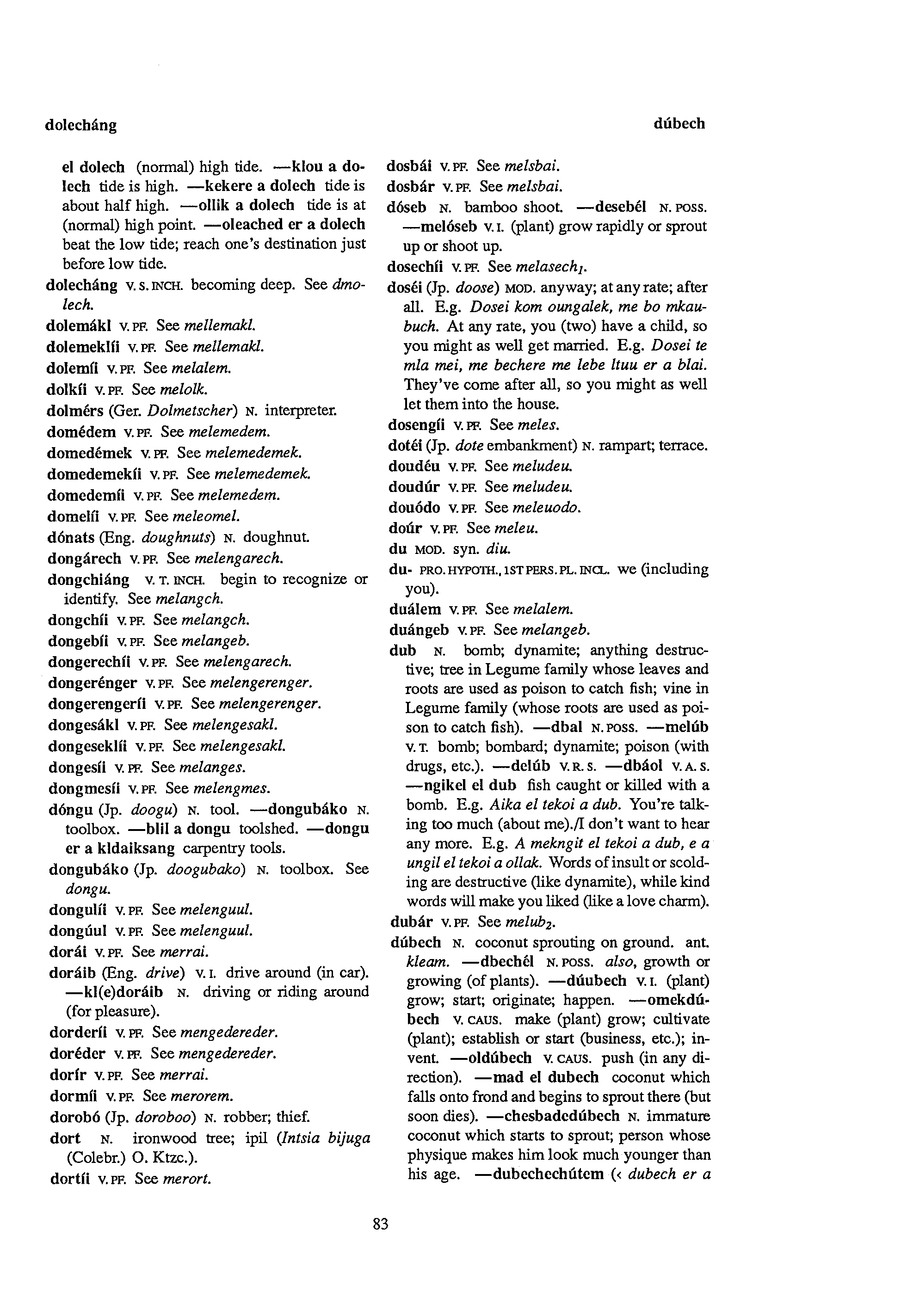
- dub in Lewis S. Josephs; Edwin G. McManus; Masa-aki Emesiochel (1977), Palauan-English Dictionary, University Press of Hawaii, →ISBN, page 83.
San Juan Guelavía Zapotec
Etymology
From Proto-Zapotec *tokwaʔ.
Noun
dub
References
- López Antonio, Joaquín; Jones, Ted; Jones, Kris (2012), Vocabulario breve del Zapoteco de San Juan Guelavía[5] (in Spanish), second electronic edition, Tlalpan, D.F.: Instituto Lingüístico de Verano, A.C., pages 14, 26
Serbo-Croatian
Etymology
Inherited from Proto-Slavic *dǫbъ, from Proto-Indo-European *dʰanw-.
Noun
dȗb m inan (Cyrillic spelling ду̑б)
- oak (wood)
- oak tree
- Synonym: hrast
- c. 1840, Dragutin Rakovac (translating Samuel Tomášik), Hej, Slaveni:
- Stijena puca, dub se lama, zemlja nek’ se trese!
- The rock cracks, the oak breaks, let the earth quake!
Declension
| singular | plural | |
|---|---|---|
| nominative | dȗb | dȕbovi |
| genitive | dȗba | dubóvā |
| dative | dȗbu | dubòvima |
| accusative | dȗb | dȕbove |
| vocative | dȗbe | dȕbovi |
| locative | dúbu | dubòvima |
| instrumental | dȗbom | dubòvima |
Derived terms
Further reading
- “dub”, in Hrvatski jezični portal [Croatian language portal] (in Serbo-Croatian), 2006–2026
- “dub”, in Hrvatski jezični portal [Croatian language portal] (in Serbo-Croatian), 2006–2026
- “dub”, in Hrvatski jezični portal [Croatian language portal] (in Serbo-Croatian), 2006–2026
Slovak
Etymology
Inherited from Proto-Slavic *dǫbъ.
Pronunciation
- IPA(key): /dup/, [ˈdup]
- Rhymes: -up
Audio (Bratislava): (file)
Noun
dub m inan (relational adjective dubový, diminutive dubček or dúbok)
Declension
| singular | plural | |
|---|---|---|
| nominative | dub | duby |
| genitive | duba | dubov |
| dative | dubu | dubom |
| accusative | dub | duby |
| locative | dube | duboch |
| instrumental | dubom | dubmi |
Further reading
- “dub”, in Slovníkový portál Jazykovedného ústavu Ľ. Štúra SAV [Dictionary portal of the Ľ. Štúr Institute of Linguistics, Slovak Academy of Science] (in Slovak), https://slovnik.juls.savba.sk, 2003–2026
Spanish
Noun
dub m (plural dubs)
Sumerian
Romanization
dub
- romanization of 𒁾 (dub)
Upper Sorbian
Pronunciation
- IPA(key): /ˈdup/
- Rhymes: -up
- Hyphenation: dub
- Syllabification: dub
Etymology 1
Inherited from Proto-Slavic *dǫ̑bъ. Cognate with Lower Sorbian dub.
Noun
dub m inan (diminutive dubičk or dubik, augmentative dubisko)
Declension
Etymology 2
See the etymology of the corresponding lemma form.
Verb
dub
- second/third-person singular personal of dubić
Further reading
Volapük
Preposition
dub
Derived terms
White Hmong
Etymology
From Proto-Hmongic *qrɛŋᴬ (“black”), related to Proto-Mienic *qri̯ɛkᴰ (“black”), though the details are unclear due to irregular rime and tone correspondences.[1]
Pronunciation
- IPA(key): /du˥/
Adjective
dub
References
- Heimbach, Ernest E. (1979), White Hmong — English Dictionary[6], SEAP Publications, →ISBN.
- ^ Ratliff, Martha (2010), Hmong-Mien language history (Studies in Language Change; 8), Canberra, Australia: Pacific Linguistics, →ISBN, page 243; 274.
Zhuang
Pronunciation
- (Standard Zhuang) IPA(key): /tup˧/
- Tone numbers: dub8
- Hyphenation: dub
Etymology 1
From Proto-Tai *dupᴬ (“to pound”); cognate with Thai ทุบ (túp), Lao ທຸບ (thup), Shan ထုပ်ႉ (thṵ̂p). Also compare Cantonese 𢱕 (dap6, “to pound; to strike”).
Verb
dub (Sawndip forms 𭡡 or 𰔥 or 𭡫, 1957–1982 spelling dub)
- to hit; to strike
- Synonym: moeb
- to strike with a hammer; to hammer
- to castrate (a male water buffalo)
Etymology 2
Verb
dub (1957–1982 spelling dub)