ston
See also: Appendix:Variations of "ston"
Middle English
Alternative forms
Etymology
Inherited from Old English stān, from Proto-West Germanic *stain, from Proto-Germanic *stainaz.
Pronunciation
- IPA(key): /stɔ̝ːn/
- Rhymes: -ɔːn
- IPA(key): /stɑːn/ (Early Middle English)
- IPA(key): /staːn/ (Northern)
Noun
ston (plural stones or ston or (early, rare) stonen)
- A stone, boulder, or pebble:
- c. 1275, Judas (Roud 2964, Child Ballad 23, Trinity College MS. B.14.39), folio 34, recto, lines 15-16; republished at Cambridge: Wren Digital Library (Trinity College), 29 May 2019:
- Iudaſ go þou on þe roc heie upon the ſton / lei þin heued i my barm, ſlep þou þe anon
- "Judas, get up on the rock, high on the stone, / rest your head on my lap and fall asleep right away!"
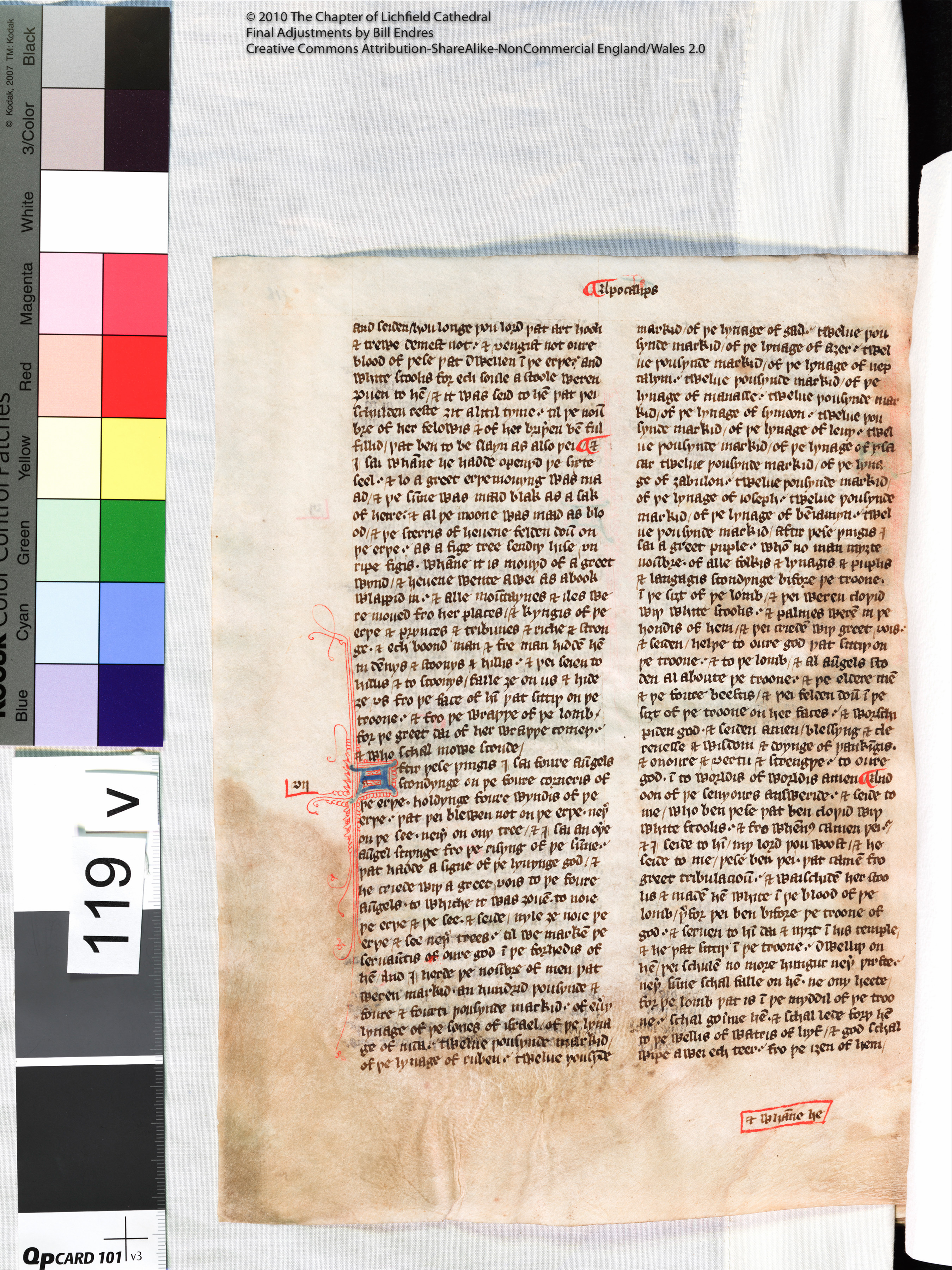
- c. 1395, John Wycliffe, John Purvey [et al.], transl., Bible (Wycliffite Bible (later version), MS Lich 10.)[1], published c. 1410, Apocalips 6:16, folio 119, verso, column 1; republished as Wycliffe's translation of the New Testament, Lichfield: Bill Endres, 2010:
- .· ⁊ þei ſeien to hillis and to ſtoonys falle ȝe on us ⁊ hide ȝe vs fro þe face of hi[m] þat ſittiþ on the troone.· ⁊ fro þe wraþþe of þe lomb ·
- And they said to hills and rocks: "Fall on us and hide us from the face of the one that sits on the throne and from the wrath of the lamb […] "
- A solid mass resembling a stone, particularly:
- Stone as a material (especially in construction)
- A stone structure or monument, especially a tomb or tombstone.
- A stone (unit of mass)
Related terms
Descendants
- English: stone (see there for further descendants)
- English: (West Yorkshire) stoan
- English: (Ottawa-Valley) stoan, staun
- Geordie: styen
- Scots: stane
- Yola: sthoan
- → Anglo-Norman: ston
References
- “stōn, n.”, in MED Online, Ann Arbor, Mich.: University of Michigan, 2007, retrieved 5 April 2018.
Polish
Pronunciation
- (Middle Polish) IPA(key): /ˈstɔn/
- (Masovia):
- (Łowicz) IPA(key): [ˈstɔn]
Noun
ston m inan
- Middle Polish form of stan (“one of the social layers into which society was divided in European countries from the 13th to the 18th centuries; belonging to such a class determined by origin or profession”)
- (Łowicz) alternative form of stan (“velvet decorated sleeveless part sewn onto a skirt”)
Declension
Attested forms of *ston
| singular | plural | |
|---|---|---|
| nominative | — | — |
| genitive | stonu | — |
| dative | — | — |
| accusative | — | — |
| instrumental | — | — |
| locative | — | — |
| vocative | — | — |
References
- “STAN”, in Elektroniczny Słownik Języka Polskiego XVII i XVIII Wieku [Electronic Dictionary of the Polish Language of the XVII and XVIII Century], 17 February 2009
- Marzena Kozanecka-Zwierz, Magdalena Bartosiewicz, Renata Marciniak-Firadza, editors (2014), “ston”, in Gwara – Księżaków "język ojczysty" Dziedzictwo regionu łowickiego (in Polish), Łowicz: Muzeum w Łowiczu, →ISBN, page 57
Sranan Tongo
Etymology
Pronunciation
- IPA(key): /stoŋ/, /ston/, [stʊ̞̃ŋ], [stɔ̝ŋ]
Noun
ston
Derived terms
- fayaston
- kubiston
- stonbangi
- stonbanti
- stonfutu
- Stonoso
- stonpopki
- stonskotu
Swedish
Noun
ston
- indefinite plural of sto
Anagrams
Tok Pisin
Etymology
Noun
ston
Volapük
Pronunciation
- IPA(key): /ston/
Noun
ston (genitive stona, plural stons)
Declension
| Singular | Plural | |
|---|---|---|
| Nominative | ston | stons |
| Genitive | stona | stonas |
| Dative | stone | stones |
| Accusative | stoni | stonis |
| Predicative1 | stonu | stonus |
| Vocative | o ston | o stons |
- Introduced in Volapük Nulik.
Derived terms
- stonacan
- stonik
- stonil
- stonön
- stonöp
Further reading
- “ston”, in Vödabuk (in English, Esperanto, and Volapük)